Embodied carbon is the greenhouse gas emitted to make, transport and install the materials in a building, as opposed to the operational carbon from running it. Upfront embodied carbon covers everything up to practical completion: extracting raw materials, manufacturing products, getting them to site and the construction work itself. It is measured in kilograms or tonnes of carbon dioxide equivalent (kgCO2e or tCO2e).
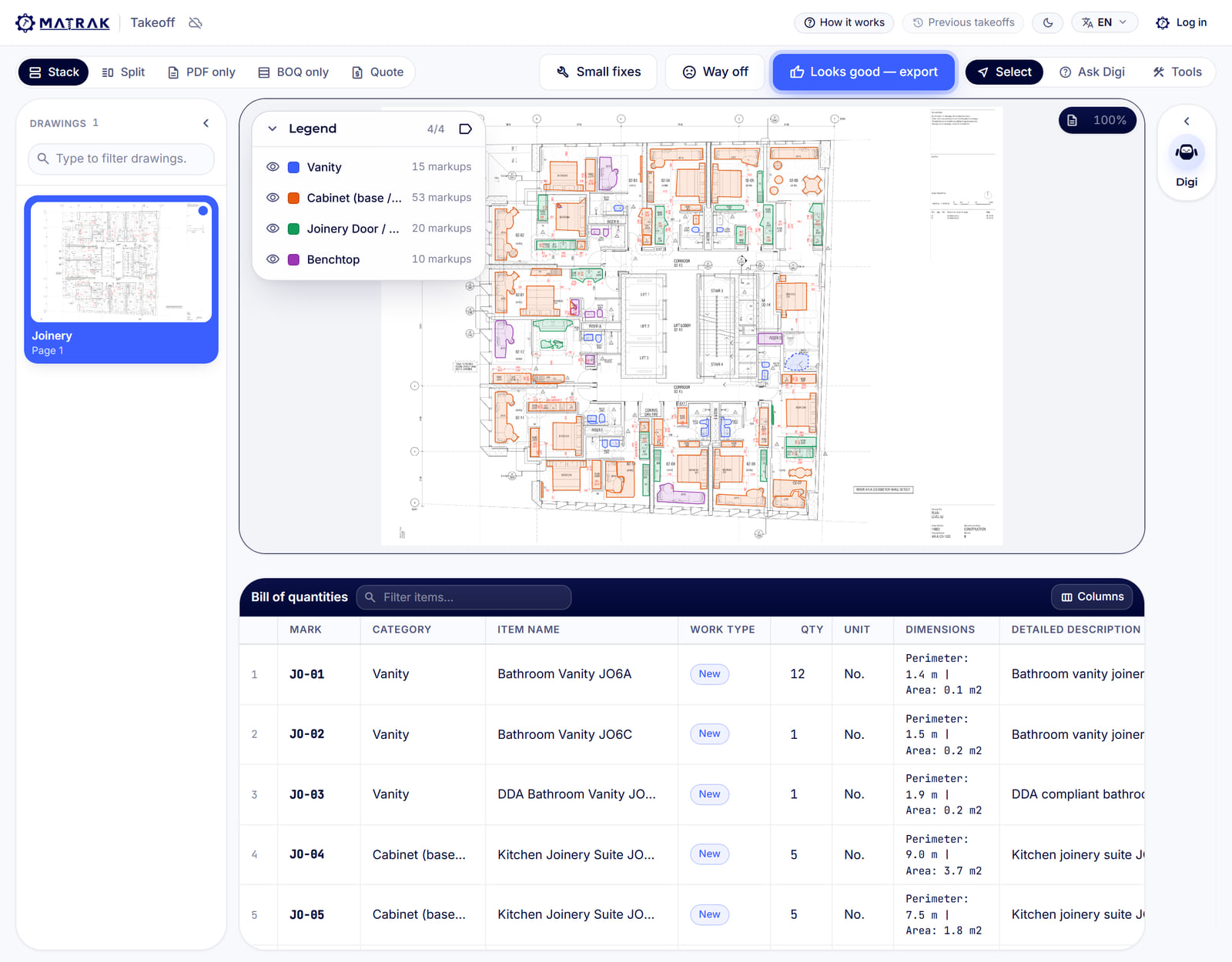
You calculate it by multiplying the quantity of each material by an emission factor for that material and adding up the results. That is why an embodied carbon calculator is only as good as the quantities you feed it.
What are the life cycle stages A1 to A5?
Life cycle assessments of buildings split emissions into lettered modules. The first five are the upfront stages:
| Module | Stage | What it covers |
|---|---|---|
| A1 | Raw material supply | Extracting and processing raw materials |
| A2 | Transport to the manufacturer | Moving raw materials to the factory |
| A3 | Manufacturing | Making the product. A1 to A3 together are the product stage, or cradle to gate |
| A4 | Transport to site | Moving products from the factory gate to the site |
| A5 | Construction and installation | Site energy, plant, and the materials wasted during construction |
Later modules cover use (B), end of life (C) and benefits beyond the building's life (D). Most reporting in Australia today is about upfront carbon, A1 to A5, and for most buildings A1 to A3 is by far the largest part.
Is embodied carbon Scope 1, 2 or 3?
For a builder, developer or building owner, most embodied carbon is Scope 3: emissions that happen in your supply chain, at the cement works, steel mill and glass plant, not on your own site. Fuel burned by your own plant on site is Scope 1, and electricity you buy for the site is Scope 2. For the manufacturer, the same emissions are its own Scope 1 and 2. This is why builders need data from suppliers to report it.
How is an embodied carbon assessment done?
- Get the quantities. A bill of quantities or quantity takeoff of every material: m3 of concrete by strength grade, tonnes of reinforcement and steel, m2 of facade, plasterboard and flooring.
- Find an emission factor for each material. Best is the supplier's own Environmental Product Declaration (EPD), which gives kgCO2e per unit for stages A1 to A3. Where there is none, use a generic factor from a recognised database or the rating tool's default.
- Multiply and add. Quantity x factor for each line, then total.
- Add transport and site emissions (A4 and A5), from distances, fuel and waste rates, or the rating tool's allowances.
- Divide by floor area to get an intensity in kgCO2e per m2, so buildings can be compared.
- Recalculate when the design changes. Each drawing revision changes the quantities, and so the number.
Already have drawings? Matrak Carbon works from your takeoff quantities and puts Scope 3 embodied carbon on every line, every revision, with nothing to key in.
Worked example: one suspended slab
The emission factors below are round numbers chosen to show the method. They are not real product data. Use the EPD for the product you are actually buying.
| Material | Quantity | Example factor (A1 to A3) | Embodied carbon |
|---|---|---|---|
| Concrete, 40 MPa | 120 m3 | 350 kgCO2e per m3 | 42,000 kgCO2e |
| Reinforcing steel | 9.6 t | 1,500 kgCO2e per t | 14,400 kgCO2e |
| Post-tensioning strand | 1.2 t | 2,000 kgCO2e per t | 2,400 kgCO2e |
| Total, A1 to A3 | 58,800 kgCO2e (58.8 tCO2e) | ||
| Intensity over 600 m2 of slab | 98 kgCO2e per m2 |
Two things stand out. First, the result is only as accurate as the quantities: a 10% error in the concrete volume moves the total by about 7%. Second, the levers are visible. A lower-carbon concrete mix changes one factor and most of the result.
Where do NABERS and Green Star fit in?
- NABERS Embodied Carbon. NABERS, the national rating system run by the NSW Government, has an Embodied Carbon rating that lets eligible new buildings and partial rebuilds measure, verify and compare their upfront embodied carbon with similar buildings. A certificate can be sought once the building reaches practical completion.
- Green Star. The Green Building Council of Australia's Green Star Buildings rating tool includes a credit for reducing upfront carbon emissions against a reference building. Check the current version of the tool for the reductions required at each rating level.
- Client and government requirements. More tenders now ask for an embodied carbon figure or a reduction target. Read the tender documents for the method and boundary they want.
These schemes set their own rules for boundaries, default factors and evidence, and they are updated often. Use the scheme's current rules, not a general guide, for any figure you submit.
What are the common mistakes with embodied carbon?
- Calculating once, at the end. By then nothing can be changed. Measure at design stage and at each revision.
- Quantities from an old revision or a rough rate per m2.
- Mixing boundaries. Comparing an A1 to A3 figure for one option with an A1 to A5 figure for another.
- Generic factors where a product EPD exists. Defaults are often conservative and can overstate the result.
- Unit errors. A factor per tonne applied to a quantity in m3.
- Leaving out the big items. Structure and facade usually dominate. Fit-out and services are harder to measure but still count.
- No evidence. A rating needs delivery dockets, EPDs and as-built quantities, not just a spreadsheet.
Related reading: embodied carbon tracking with Matrak and the best AI takeoff software.
Embodied carbon in Matrak
How Matrak does it. Matrak's Carbon module puts Scope 3 embodied carbon on every line of your bill, every revision. It works from your takeoff quantities, so the carbon figure is built on the same measured bill you price from, and it updates when a new drawing revision changes the quantities. Carbon is free to switch on and pay as you go: $89 a credit with no subscription, or from $65 a credit on a monthly plan (A$, plus GST). It is in early access: you can price it and add it to your Matrak today.
Why it is less work. Embodied carbon assessment is baked into the takeoff: the AI measures the whole project, over 1,000 documents in one pass, and the carbon sits on the same bill. An AI agent can re-run it as new drawings land in Procore, Aconex or Autodesk, on approved versions only if you choose, so the number is always the current design's. Every change is kept in a full audit history, whether a person or the AI made it.
Frequently asked questions
What is embodied carbon in construction?
It is the greenhouse gas emitted in making, transporting and installing building materials, and later maintaining and disposing of them. Upfront embodied carbon is the part emitted before the building is finished.
What is the difference between embodied carbon and operational carbon?
Embodied carbon comes from the materials and the construction work. Operational carbon comes from the energy used to run the building once it is occupied, such as heating, cooling and lighting.
How do you calculate embodied carbon?
Multiply the quantity of each material by its emission factor, in kgCO2e per unit, and add the results. Then add allowances for transport to site and construction, and divide by floor area to compare buildings.
What is an EPD?
An Environmental Product Declaration is a verified document from a manufacturer that states the environmental impact of a product, including its carbon emissions per unit for each life cycle stage.
Which materials have the most embodied carbon in a building?
In most buildings the structure and envelope dominate: concrete, reinforcing and structural steel, aluminium and glass. The exact split depends on the design.
Is embodied carbon reporting mandatory in Australia?
Requirements vary by state, planning authority and client, and they are changing. Many projects measure it because a rating such as NABERS or Green Star, or the tender, asks for it. Check the rules that apply to your project.
Is embodied carbon the carbon footprint of construction?
For most new buildings it is the largest part of it. The carbon footprint of construction itself, everything up to practical completion, is the upfront embodied carbon in stages A1 to A5. A building's whole-life footprint adds the operational carbon from running it.
Sources
- NABERS: Embodied Carbon rating
- Matrak: embodied carbon tracking
- Life cycle modules A1 to A5 are defined in EN 15978, the European standard for assessing the environmental performance of buildings, which Australian rating tools draw on. Green Star is run by the Green Building Council of Australia. Check each scheme's current rules.
Last reviewed 18 November 2026. This guide is general information for people working in construction. It is not legal or contract advice. Check your own contract and the current legislation, or ask a construction lawyer, before you rely on it.