Quality assurance (QA) is the planning and the system that give confidence the work will be built right. Quality control (QC) is the checking that confirms a piece of work was built right. QA happens before and around the work: procedures, approved methods, trained people, inspection and test plans. QC happens at the work: inspections, measurements and tests against a pass mark.
The ISO 9000 vocabulary puts it in one line each. Quality assurance is the part of quality management focused on providing confidence that quality requirements will be fulfilled. Quality control is the part focused on fulfilling quality requirements. On site, the short version is: QA prevents defects, QC finds them.
QA vs QC: side by side
| Quality assurance (QA) | Quality control (QC) | |
|---|---|---|
| Aim | Prevent defects | Find and fix defects |
| Focus | The process: how the work will be done and checked | The product: the work that was actually built |
| When | Before work starts, and by audit during the job | During and after each activity |
| Who | Quality manager, project manager, each subcontractor's management | Supervisors, site engineers, inspectors, testers |
| Typical documents | Project quality plan, approved ITPs, method statements, material approvals, audit reports | Completed checklists, test results, signed hold points, defect lists, NCRs |
| Question it answers | Are we set up to get this right? | Did we get this right? |
What does QA look like on a construction site?
- A project quality plan that says who is responsible for what.
- An inspection and test plan for each trade, approved before that trade starts.
- Material and sample approvals, so the right product is ordered.
- Checking that subcontractors are licensed and their people are trained for the system being installed.
- A first-install or sample room inspected and agreed before the trade repeats it on every level.
- Control of drawing revisions, so nobody builds from an old one.
- Audits: picking a sample of completed records and checking they are real, complete and on time.
What does QC look like on a construction site?
- The pre-pour inspection of reinforcement against the drawings.
- A slump test and test cylinders for each concrete delivery.
- A flood test of a waterproofed bathroom before tiling.
- Checking fire stopping at each penetration before the ceiling closes.
- Measuring set-out, levels and tolerances.
- A defects inspection of each apartment before handover.
One document sits in both camps. Writing and approving the ITP is QA. Filling it in at the work, line by line, is QC.
Want the plan and the checks in one place? Matrak Quality builds your ITPs from your drawings and shows which checks are done, by level and room, with every trade signing off on their own phone.
Worked example: a concrete slab
| Stage | QA (set up to get it right) | QC (check it is right) |
|---|---|---|
| Before the trade starts | Mix design approved, ITP approved, hold points agreed with the engineer | |
| Formwork and reinforcement | Current drawing revision issued to the crew | Reinforcement inspected and released by the engineer (hold point) |
| Pour | Pour sequence and curing method agreed | Dockets checked, slump tested, cylinders taken |
| After the pour | Audit: are the pour records complete for every pour so far? | Cylinder results checked against specified strength before stripping |
| If something fails | Find the cause and change the method | Raise a non-conformance report and fix the work |
Quality assurance and quality control in construction projects
A project needs both. QC with no QA means inspecting defects out of the building one at a time, which is slow and costly, because the same mistake is repeated on every level before anyone changes the method. QA with no QC is a folder of procedures that nobody can prove were followed. When a check fails, the fix to the work is QC, and the fix to the cause is QA. That loop is what a non-conformance report records.
Who is responsible for QA and QC?
- Each subcontractor is responsible for the quality of its own work: its own QA (method, trained people) and first-line QC (self-inspection on the ITP).
- The head contractor sets the project's QA system, approves ITPs, signs hold points and audits the subcontractors' records.
- Third parties such as the engineer, building surveyor or certifier inspect at the points the law or contract requires.
- The client may audit the head contractor's system or appoint its own inspector.
What are the common mistakes with QA and QC?
- Treating QA as paperwork. If the ITP is written to win the tender and never opened again, it is not assurance.
- Relying on the final inspection. Finding a waterproofing fault at handover means pulling up tiles. Check at the hold point.
- The head contractor doing the subcontractor's QC. The trade must inspect its own work first.
- Records filled in later. A checklist completed from memory is neither QA nor QC.
- No feedback loop. Repeated defects with no change to the method.
- Nobody can see the status. If it takes a day to find out which rooms are signed off, problems are found late.
Related guides: ITP templates for three trades, practical completion and the best construction quality management software.
QA and QC in Matrak
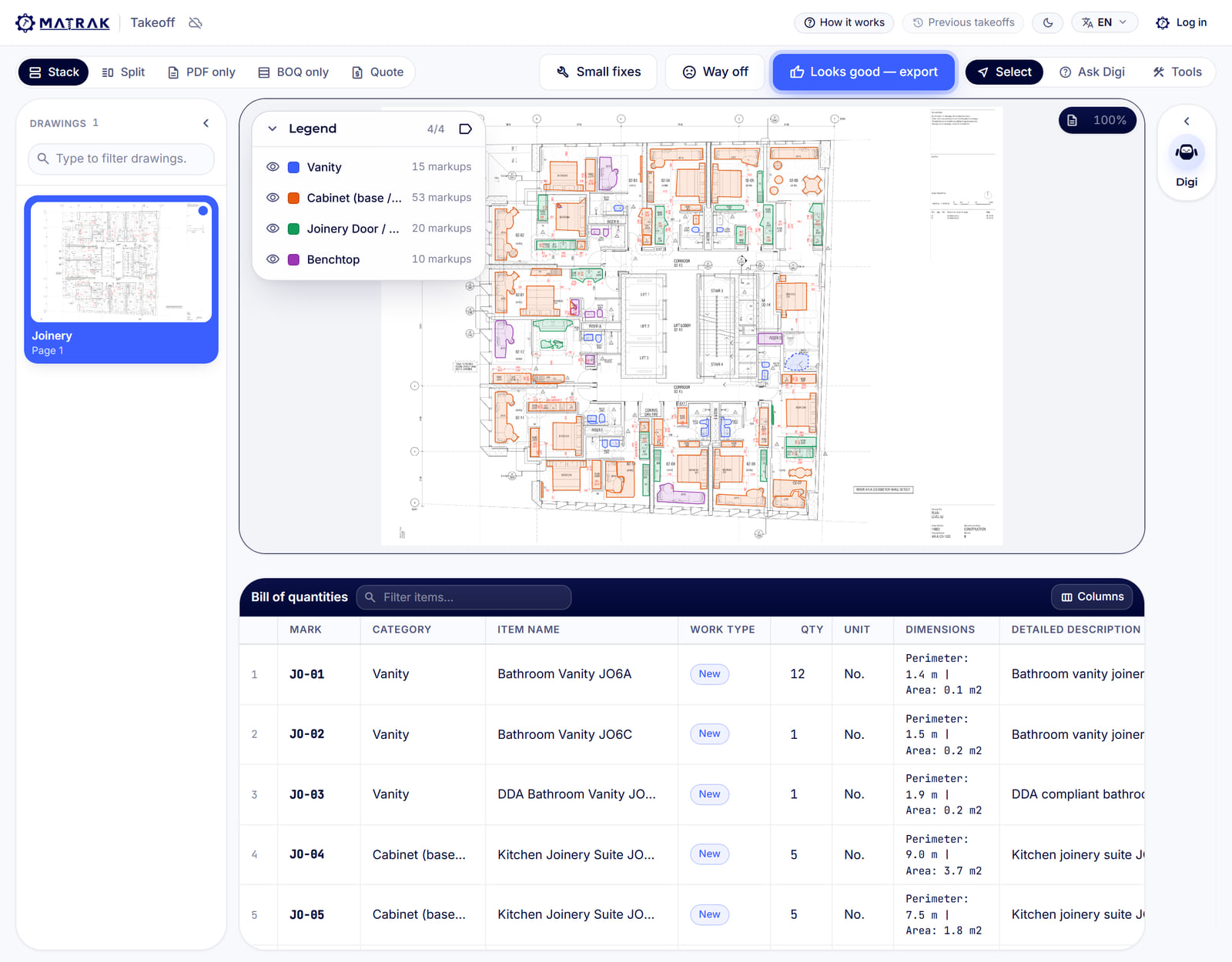
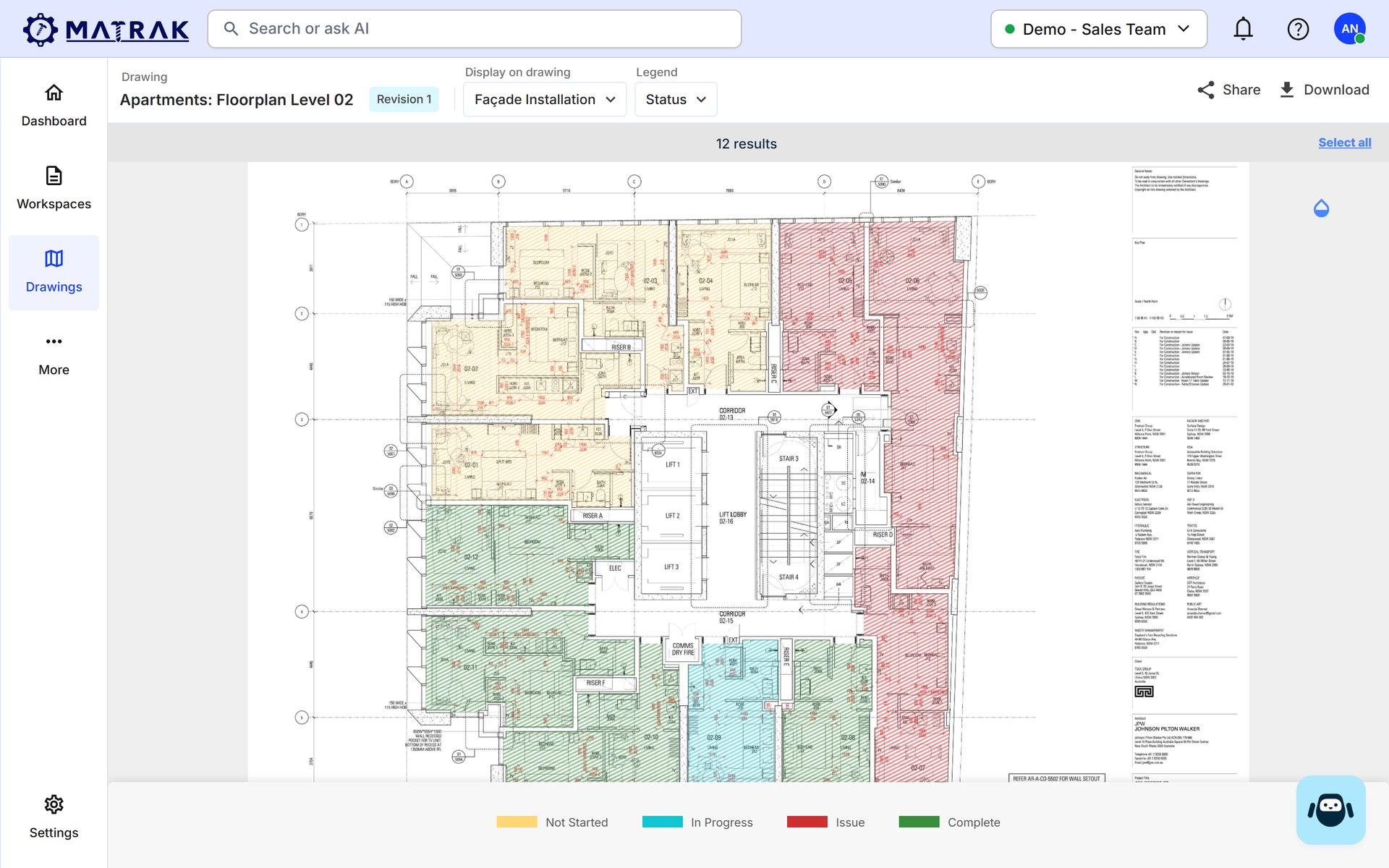
How Matrak does it. Matrak's Quality module builds ITPs, inspections and sign-offs from your drawings (the QA), and your team and subcontractors complete the checks on the phone app with photos (the QC). Each ITP's status follows its checks: In Progress when a check is answered, Issues when one fails, Complete when all pass. Hold points make work wait for the right sign-off, and every change is kept with who made it and when. Quality is $18,000 for one project for a year, or from $96K a year for every project, with 50 subcontractor companies included (A$, plus GST).
Why it is less work. The set-up is done for you from the drawings, and they are the same drawings that drive AI takeoff, supply chain and progress, so nothing is keyed in twice. Matrak integrates with Procore, Aconex and Autodesk, so the drawings are fetched with nothing to download and new revisions are picked up as they land. Your own staff are free. Every change is kept in a full audit history, whether a person or the AI made it.
Frequently asked questions
What is the main difference between QA and QC?
Quality control vs quality assurance in construction comes down to timing. QA is about the process and aims to prevent defects before they happen. QC is about the product and aims to find and fix defects in work that has been done.
Is an ITP quality assurance or quality control?
Both. Preparing and approving the inspection and test plan is quality assurance. Carrying out and recording the inspections on it is quality control.
Which comes first, QA or QC?
QA comes first, because it sets out how the work will be done and checked. QC then follows the work. Results from QC feed back into QA when a method needs to change.
Who is responsible for quality on a construction project?
Each subcontractor is responsible for its own work, and the head contractor is responsible to the client for the whole job. Engineers and certifiers inspect at set points but do not take over that responsibility.
Is a QA/QC plan required in Australia?
Most commercial and government contracts require a project quality plan and ITPs, and many head contractors are certified to ISO 9001. The requirement normally comes from the contract and specification, so check yours.
Sources
- ISO 9000 (quality management systems, fundamentals and vocabulary) defines quality assurance and quality control. ISO 9001 sets the requirements most construction quality systems follow. Check the current editions with ISO or Standards Australia.
- Matrak: quality tracking in Matrak
Last reviewed 18 November 2026. This guide is general information for people working in construction. It is not legal or contract advice. Check your own contract and the current legislation, or ask a construction lawyer, before you rely on it.