Practical completion is the point where the building work is finished except for minor defects and omissions that do not stop it being used for its intended purpose. It is not the same as 100% finished. In most Australian construction contracts it is the most important date on the job, because it starts the defects liability period, stops liquidated damages and moves responsibility for the site back to the owner.
The practical completion definition that counts is the one in your contract. Standard contracts such as the AS 4000 family usually also require that the tests the contract asks for have been passed and that documents such as warranties, manuals and as-built drawings have been handed over. This guide is general information, not legal advice.
What does practical completion mean for home building?
Home building laws use their own words. In New South Wales, the government's guidance says residential building work is complete when it matches the requirements of the contract. Where the contract does not say, the work is regarded as complete when it can be used for its intended purpose and is free of major defects. The NSW statutory warranty periods run from that completion date.
Who decides that practical completion has been reached?
Under contracts with a superintendent, the contractor asks for a certificate when it believes the work has reached practical completion. The superintendent inspects and either issues the certificate of practical completion, stating the date, or gives reasons why not. Under simpler contracts the owner and builder agree it at a handover inspection. Either way, get the date in writing.
What is a handover inspection?
A handover inspection is the walk-through where the owner or the superintendent checks the finished work against the contract before taking the keys. On a new home it is often called a pre handover inspection. A building handover inspection on a larger job goes level by level and room by room, and covers the services as well as the finishes. What it finds becomes the agreed defects list.
Practical completion inspection checklist
Walk the building with this practical completion checklist before the superintendent does. An owner can use the same rows as a pre handover inspection checklist.
| Area | What should be done | Evidence |
|---|---|---|
| The works | All work complete except agreed minor defects and omissions | Inspection record, defects list |
| Defects | No defect that stops the building being used. Minor ones listed with dates | Agreed defects list |
| Testing and commissioning | Services tested, commissioned and witnessed as the contract requires | Commissioning reports |
| Quality records | ITPs complete and signed, non-conformance reports closed | ITP register, NCR register |
| Authority approvals | Occupancy permit or occupation certificate, and other approvals the contract lists | Certificates |
| Fire and life safety | Essential safety measures installed, tested and certified | Certificates, fire engineer sign-off |
| Handover documents | As-built drawings, operation and maintenance manuals, warranties, keys | Transmittal |
| Training | Owner's team shown how to run the building, where the contract asks for it | Attendance record |
| Site | Cleaned, temporary works and plant removed | Final inspection |
The quality records are what usually hold things up. If ITPs were filled in as the work was done, this line is an export. If not, it is weeks of chasing. See what an ITP is in construction.
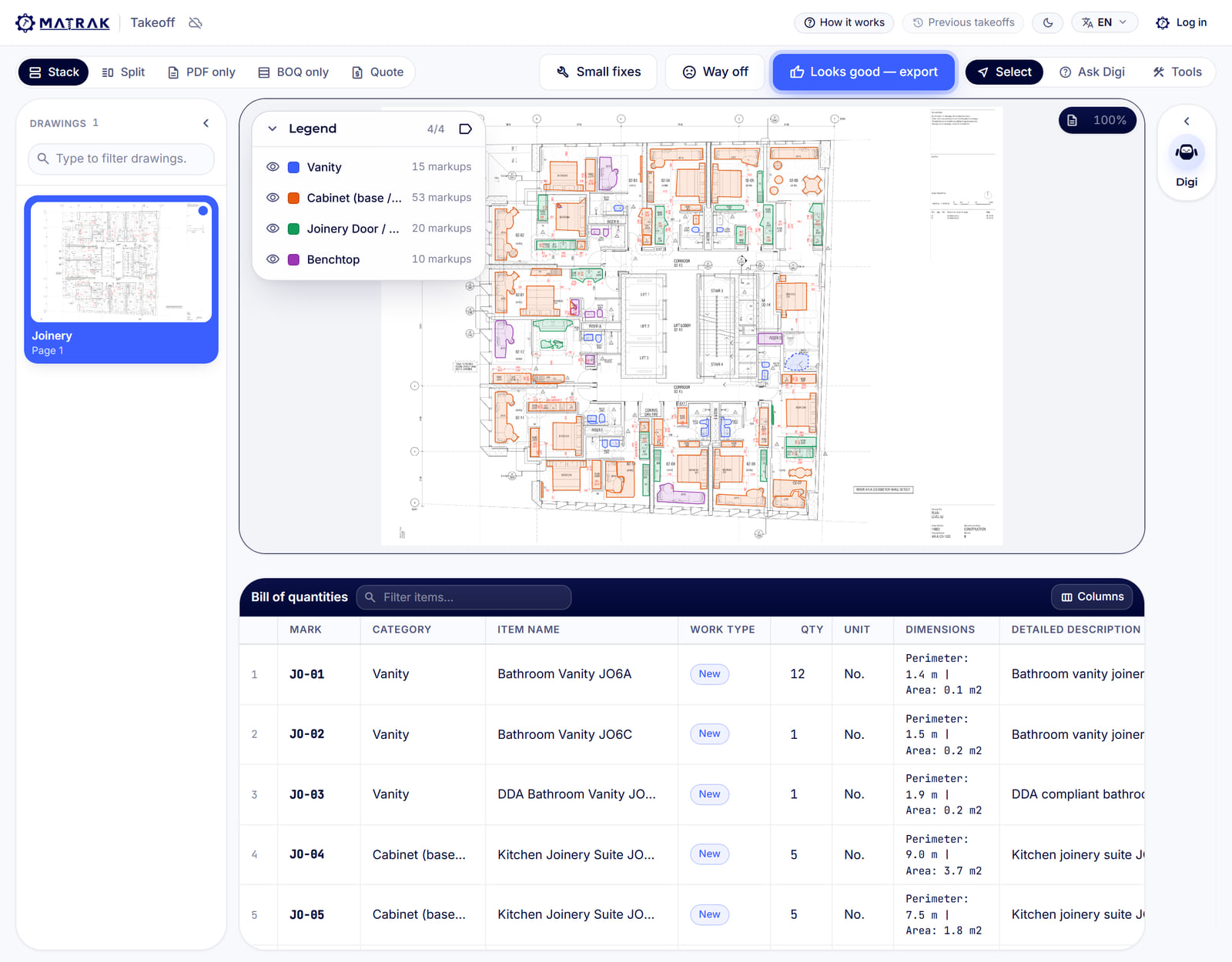
Want handover without the last-minute scramble? Matrak Quality and Defects are set up from your drawings and show what is signed and what is still open, by level and room.
What does practical completion trigger?
Under most Australian construction contracts, reaching practical completion sets off the following. Your own contract decides the detail.
- The defects liability period starts. See our guide to the defects liability period.
- Liquidated damages stop. If the job is late, damages for delay are counted up to this date.
- Possession and risk pass back to the owner, who normally takes over insurance of the works.
- Part of the security or retention is commonly released, with the rest held until the end of the defects liability period. The split is in your contract.
- A payment milestone is often reached, such as the final stage payment in a home building contract.
- Warranty clocks start. In NSW, statutory warranty periods for home building run from completion.
Practical completion vs final completion: what is the difference?
| Practical completion | Final completion | |
|---|---|---|
| When | Works are usable, with only minor defects left | The defects liability period has ended and defects are fixed |
| Document | Certificate of practical completion | Final certificate |
| Security or retention | Commonly part released | Balance released |
| Payment | Claim for the works to date | Final payment claim and final account |
| Liability | Defects liability period begins | Contract period ends, but legal liability for defects continues |
What are the common mistakes at practical completion?
- Arguing about the definition at the end. Read the contract's definition at the start and plan the handover documents from day one.
- A defects list that keeps growing. Inspect early and by area, so the list is shrinking as the date approaches.
- Missing documents. Manuals, warranties and as-builts are often part of the test. Collect them from subcontractors as each trade finishes.
- Open hold points and NCRs. An unsigned hold point on fire stopping can stop the occupancy certificate.
- No written date. The defects liability period, damages and security all hang off the date. Record it.
- Owner moving in early. Taking possession before the certificate can affect who carries risk and whether completion is taken to have happened. Get advice first.
Related guides: punch list vs snag list vs defects list, non-conformance reports and progress claims.
Getting to practical completion with Matrak
How Matrak does it. Matrak's Quality module builds your ITPs, inspections and sign-offs from your drawings, and each ITP's status follows its checks, so you can see by level and room what is complete, in progress or has issues. The Defects module logs each defect on the drawing, sends it to the right trade and shows it close. Quality is $18,000 for one project for a year, with 50 subcontractor companies included. Defects for a team is $7,200 for one project for a year (A$, plus GST).
Why it is less work. The set-up is done for you from the drawings, and they are the same drawings that drive AI takeoff, supply chain and progress, so nothing is keyed in twice. Matrak integrates with Procore, Aconex and Autodesk, so the drawings are fetched with nothing to download and new revisions are picked up as they land. Your own staff are free. Every change is kept in a full audit history, whether a person or the AI made it.
Frequently asked questions
What is practical completion in simple terms?
The building is finished enough to be used for what it was built for, with only minor defects or omissions left that can be fixed without getting in the way.
Can practical completion be reached with defects outstanding?
Yes, if they are minor and do not stop the building being used for its intended purpose. They go on an agreed list and are fixed during the defects liability period.
Is practical completion the same as an occupancy permit or occupation certificate?
No. The certificate from the building surveyor or certifier says the building is suitable to occupy under building law. Practical completion is a contract test. Many contracts make the certificate one of the conditions of practical completion.
Who issues the certificate of practical completion?
Under contracts with a superintendent, the superintendent issues it after inspecting the works. Under simpler contracts, the owner and builder agree and record the date at handover.
What happens if the owner and builder disagree about practical completion?
Follow the dispute steps in the contract. The superintendent must give reasons for refusing a certificate, and those reasons become the list of work to finish. Get advice early if payment or damages depend on the date.
How do contracts define practical completion?
Most say the works are complete except for minor defects and omissions that do not stop the building being used, the required tests have been passed and the required documents have been handed over. The wording differs between contracts, so read your own.
What goes in a notice of practical completion?
A notice of practical completion is the contractor's written notice that it believes the works have reached practical completion, asking for the certificate. A simple notice of practical completion template has the project and contract, the date you say it was reached, the clause you rely on, the minor defects and omissions still open, and the handover documents attached.
Substantial completion vs practical completion: is there a difference?
They mark the same point. Substantial completion is the term used in the United States. Practical completion is used in Australia, New Zealand and the United Kingdom. Either way the owner can use the building and the defects period starts, and the exact test is in the contract.
Sources
- NSW Government: Contracts for residential building work
- Holding Redlich: Decoding design and construct contracts, defects (AS 4902 clause 35)
- Standards Australia: AS 4000:2025 General conditions of contract
Last reviewed 18 November 2026. This guide is general information for people working in construction. It is not legal or contract advice. Check your own contract and the current legislation, or ask a construction lawyer, before you rely on it.