The defects liability period (DLP) is a set time after practical completion during which the contractor must come back and fix defects in the work at their own cost. In Australian commercial contracts it is usually 12 months, but the length is whatever your contract says. It is a contract right, and it sits on top of (not instead of) the warranties the law gives building owners.
This guide covers how the DLP in construction works under the common Australian standard contracts, how it differs from statutory warranty periods for home building, and how to run the defects list so the period ends cleanly. It is general information, not legal advice.
How long is the defects liability period?
There is no single legal length. Under the AS 4000 family of contracts, including the AS 4902 design and construct contract, the parties write the period into the annexure to the contract. Holding Redlich's guide to AS 4902 notes it is usually nominated as 12 months but is negotiable, and that it starts on the date of practical completion. Shorter periods are common for simple work such as earthworks, and longer ones for complex services or facades.
For home building in Queensland, the QBCC says a contract for a new build or major renovation should include a defects liability period of 6 or 12 months. Subcontracts often run their DLP from the head contract's practical completion, not from when the subcontractor finished, so read the dates carefully.
What happens during the DLP?
- The principal or superintendent finds a defect and directs the contractor to fix it, usually with a date.
- The contractor (in practice, the responsible subcontractor) returns, fixes it and shows it is fixed.
- If the contractor does not fix it in time, the principal can generally have someone else do the work and recover the cost from the contractor, often from the security or retention it still holds.
- Work that is rectified can get its own fresh defects period, capped at the length of the original one, under AS 4902.
- At the end of the period, with defects closed, the remaining security is released and the final certificate process starts.
The DLP helps both sides. The owner gets defects fixed without a legal claim. The contractor gets the chance to fix its own work, which costs far less than paying another builder's price.
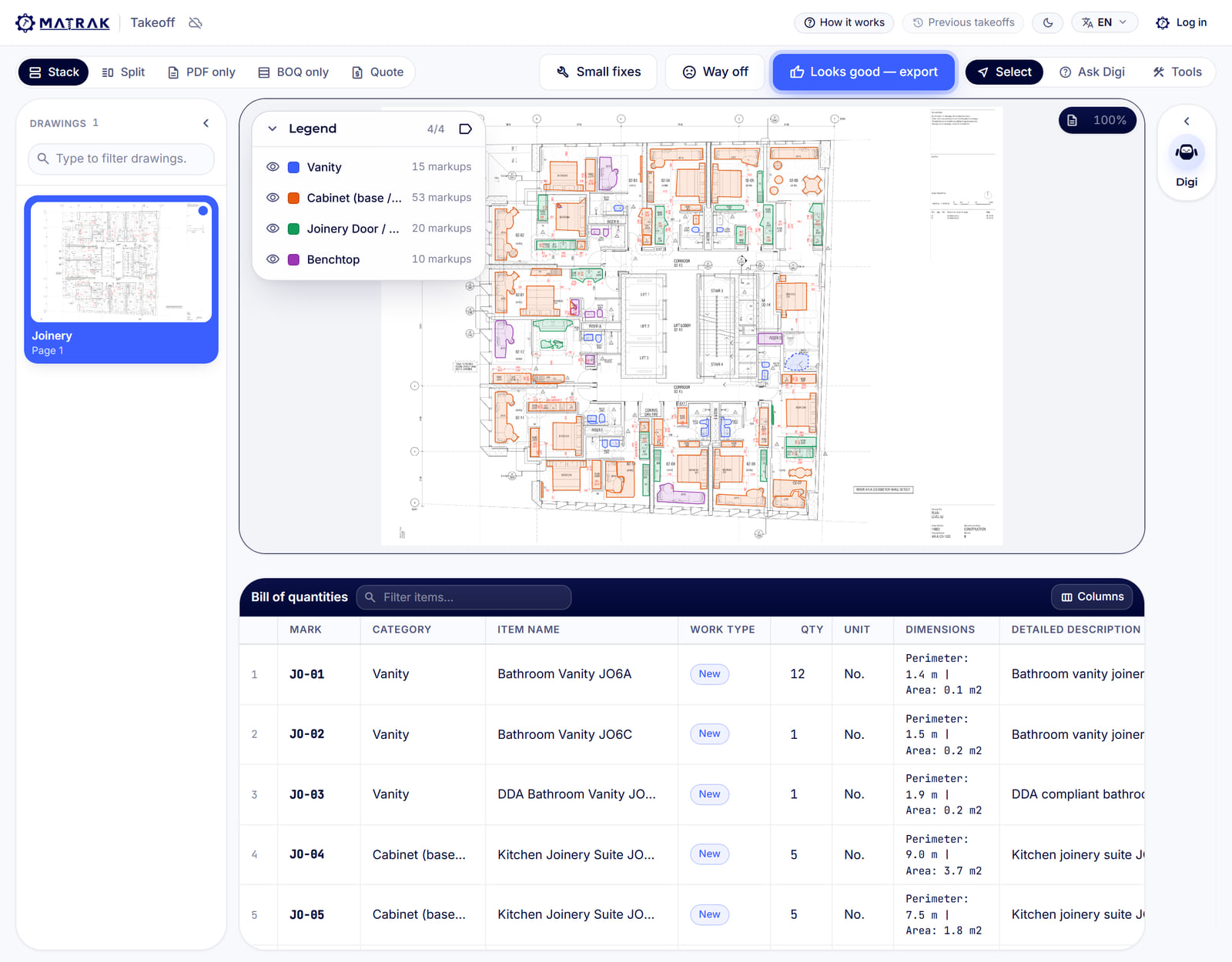
Chasing DLP defects by email and spreadsheet? Matrak Defects puts every defect on the drawing, sends it to the trade that owns it and chases it until it is closed, with 50 subcontractor companies included.
Is the DLP the same as a statutory warranty?
No. The DLP is a contract term. Statutory warranties are rights given by state and territory home building laws. They apply to residential work, run for much longer, and cannot be signed away. The end of the DLP does not end the builder's liability.
| Defects liability period | Statutory warranty (home building) | |
|---|---|---|
| Where it comes from | Your contract | State or territory legislation |
| Applies to | Any project where the contract includes one | Residential building work |
| Typical length | Often 12 months from practical completion | Years, set by each state (see below) |
| Remedy | Contractor returns and fixes at its own cost | A claim through the regulator, tribunal or court |
| Can it be contracted out of? | It is negotiated | No |
Statutory periods by state: three examples
| State | What the government source says | Source |
|---|---|---|
| New South Wales | Statutory warranties run for six years for major defects and two years for all other defects, from the date the work was completed | NSW Government |
| Victoria | Implied warranties apply to all home building work and cannot be signed away. Action can be brought against a builder for up to 10 years from the date the work was completed | Consumer Affairs Victoria |
| Queensland | A complaint to the QBCC must be lodged within 12 months of noticing a structural defect, or within 12 months of completion for a non-structural defect | QBCC |
Other states and territories have their own periods and rules, and all of these are changed from time to time. Check your state's building regulator, and your contract, before relying on any date.
Who fixes what during the DLP?
- Defects (work not built to the contract): the contractor, at its own cost. The head contractor passes each one to the subcontractor whose work it is.
- Damage by the occupants, or fair wear and tear: not a defect. The owner pays.
- Maintenance (filters, adjusting doors after settling): depends on the contract. Many contracts list what maintenance the contractor does during the DLP.
- Design faults: depends on who carried the design. Under design and construct, usually the contractor.
How do you manage the defects list through the DLP?
| When | What to do |
|---|---|
| Before practical completion | Inspect every room, log each defect with a photo and a location, and assign it to a trade |
| At practical completion | Agree the list of minor defects still open and a date for each |
| During the DLP | Log new defects as they are reported, with the date reported and the date due |
| Monthly | Review open defects by trade, and warn early where security may be called on |
| Four to six weeks before the DLP ends | Do a final inspection and issue the last list in time for it to be fixed inside the period |
| End of the DLP | Confirm every defect is closed with evidence, then process the release of security |
What are the common mistakes with the DLP?
- Not recording the date of practical completion. Every DLP date hangs off it. See practical completion.
- Subcontract DLPs that end before the head contract's. The builder is left holding defects it cannot pass down.
- Defects reported by phone. With no written notice and date, you cannot show the contractor was told in time.
- One long list with no owner. A defect nobody is assigned to does not get fixed.
- Fixing a defect yourself without notice. Under most contracts you must give the contractor the chance first, or you may not recover the cost.
- Treating the end of the DLP as the end of liability. Statutory warranties and ordinary contract claims continue.
Related guides: punch list vs snag list vs defects list, non-conformance reports and the best construction defect management software.
How Matrak does it. With Matrak's Defects module you log a defect on the drawing, send it to the right trade and watch it close. On the phone app you open the drawing, tap the room or item, choose Report defect, add photos and save. The defect is linked to that spot and that record, the trade is told, and overdue items are chased for you by email and in the app. Defects for a team is $7,200 for one project for a year with 50 subcontractor companies included, or $3,600 for your own company only (A$, plus GST). Defects is in early access: you can price it and add it today.
Why the trades use it. Your own staff are free and 50 subcontractor companies come with the module, so every trade works from its own list on its own phone. The defect sits on the same drawings as the ITPs, the progress and the products that were installed. Matrak integrates with Procore, Aconex and Autodesk, so the drawings are fetched with nothing to download and new revisions are picked up as they land. Every change is kept in a full audit history, whether a person or the AI made it.
Frequently asked questions
How long is the defects liability period in Australia?
It is set by the contract. Twelve months from practical completion is the most common figure in commercial contracts, and home building contracts often use 6 or 12 months. Check the annexure or schedule of your own contract.
When does the defects liability period start?
Under the common Australian standard contracts, including AS 4902, it starts on the date of practical completion. Get that date in writing.
Is the builder still liable after the defects liability period ends?
Yes. The DLP only covers the right to have the contractor return and fix defects. Statutory warranties for home building and ordinary claims under the contract can run for years longer.
What is the difference between the defects liability period and the warranty period?
The DLP is a short contract period for fixing defects after completion. A statutory warranty period is set by state law for residential work, is much longer, and cannot be contracted out of. Product warranties from manufacturers are separate again.
Can the owner use another builder to fix defects during the DLP?
Usually only after the original contractor has been told about the defect and has failed to fix it in the time allowed. Check the notice steps in your contract first.
Sources
- Holding Redlich: Decoding design and construct contracts, defects (AS 4902 clause 35)
- Standards Australia: AS 4000:2025 General conditions of contract
- NSW Government: Contracts for residential building work
- Consumer Affairs Victoria: Implied warranties on home building work
- QBCC: Help with defective work
Last reviewed 18 November 2026. This guide is general information for people working in construction. It is not legal or contract advice. Check your own contract and the current legislation, or ask a construction lawyer, before you rely on it.