A progress claim is a request for payment for construction work done, or goods and services supplied, up to a set date. It lists each part of the contract, how much of it is complete, what has been claimed before and what is being claimed now. In Australia a progress claim that follows the rules is also a payment claim under your state's security of payment law, which gives you set times to be answered and paid.
Below is a payment claim template you can copy, the basics of security of payment, and the reasons claims get cut. This is general information, not legal advice.
What goes in a progress claim?
- Who is claiming and who is being claimed from, with ABNs, and the contract or purchase order it is made under.
- A claim number and the date the work is claimed up to (the reference date in many contracts).
- Each line of the contract sum or schedule, with the percent or quantity complete.
- Approved variations, listed separately with their approval reference.
- Materials on or off site, if the contract lets you claim them.
- Less retention, less the amount previously claimed, plus GST.
- The amount claimed now, and any statement the law in your state requires on the claim.
Progress claim template
| Item | Description | Contract value | % complete | Value to date | Previously claimed | This claim |
|---|---|---|---|---|---|---|
| 1 | Preliminaries | $40,000 | 50% | $20,000 | $14,000 | $6,000 |
| 2 | Level 1 partitions and ceilings | $120,000 | 100% | $120,000 | $96,000 | $24,000 |
| 3 | Level 2 partitions and ceilings | $120,000 | 40% | $48,000 | $0 | $48,000 |
| V01 | Variation: extra bulkheads, level 1 (approved) | $8,000 | 100% | $8,000 | $0 | $8,000 |
| Subtotal | $288,000 | $196,000 | $110,000 | $86,000 | ||
| Less retention at 5% of this claim | -$4,300 | |||||
| Claimed this period, before GST | $81,700 | |||||
| GST at 10% | $8,170 | |||||
| Total claimed, including GST | $89,870 |
The figures are an example for a partitions subcontract. Retention rules, what you can claim for materials and when you can claim all come from your contract. If the other party issues its own payment claim form, use theirs and attach this schedule.
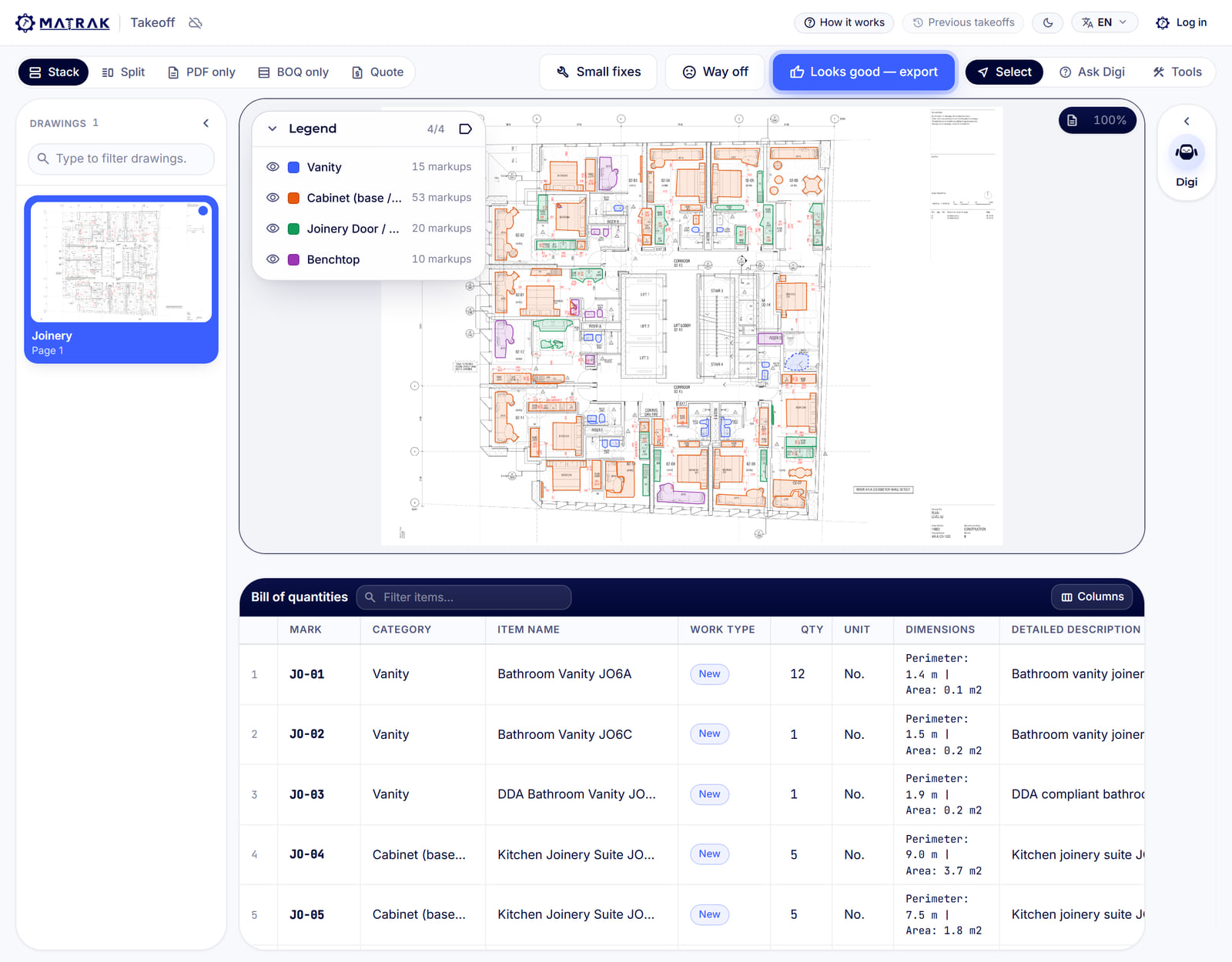
Is your claim based on what is really done on site? Matrak Claims checks each progress claim against the drawings and against what has actually been completed, trade by trade.
How do you prepare a progress claim?
- Check the contract for the claim date, who it goes to, the format and how it must be sent.
- Measure what is done at the claim date, by location, from site records and not from memory.
- Fill in the schedule: percent or quantity complete for each line, to date.
- Add approved variations separately. Put unapproved ones on a separate list so they do not hold up the rest.
- Take off retention and previous claims, add GST.
- Attach the evidence: marked-up drawings, photos, delivery dockets, signed ITPs, and any supporting statement your state requires.
- Send it on time, the way the contract says, and keep proof of when it was sent.
What does security of payment law give you?
Every Australian state and territory has security of payment legislation. The details differ, but the core is the same: a right to progress payments, a deadline for the other party to respond with a payment schedule saying what it will pay and why, a deadline for payment, and fast adjudication if you are not paid. In NSW the government says the right applies to all contractors doing construction work or supplying goods or services under a construction contract, whether the contract is written or verbal.
| State | Time to respond with a payment schedule | Notes from the government source |
|---|---|---|
| New South Wales | 10 business days after the claim | Payment is due within 15 business days from a principal to a head contractor and 20 business days from a head contractor to a subcontractor (10 for residential work). A contract can set shorter times |
| Queensland | 15 business days after the claim, or earlier if the contract says | Not responding and not paying can be an offence under the BIF Act, and the claimant can suspend work or go to adjudication |
| Victoria | Check the Building and Plumbing Commission's current guidance | Victoria's security of payment Act has been reformed recently, so do not rely on older summaries |
| WA, SA, Tasmania, ACT, NT | Check your state or territory's Act and regulator | Each has its own legislation and time limits |
These deadlines are strict and they change. A respondent who misses the payment schedule deadline can become liable for the full amount claimed. Check the current rules with your state regulator before you rely on a date.
Why do progress claims get knocked back?
- Claimed ahead of the work. The percent claimed does not match what the assessor sees on site. This is the most common reason for a cut.
- Unapproved variations mixed in. Construction variation claims that are not yet approved can hold up the whole claim.
- No evidence. No photos, dockets or signed quality records to back the percentages.
- Defects or incomplete quality records. Many contracts tie payment to signed ITPs for the work claimed.
- Wrong date, wrong person or wrong format. A claim served late or to the wrong address may not count.
- Arithmetic. Previous claims do not add up, or retention is worked out on the wrong amount.
- Missing statements. Some states require a supporting statement or declaration with certain claims.
How do you check a claim against what is done on site?
Whether you are making the claim or assessing it, the fair test is the same: can each percentage be traced to something on site? Break the schedule down by location (level, zone, unit), record progress against the same breakdown as the work happens, and attach that record to the claim. Disputes shrink when both sides are looking at the same list. A site diary and a current variation register do most of the work. Head contractors should also check the claim against the bill of quantities. Comparing claim tools? See Matrak vs Payapps.
Progress claims in Matrak
How Matrak does it. Matrak's Claims module checks progress claims against what is actually done on site. Because subcontractors update the status of their work in Matrak as they go, the progress claim report is built from those records: quantities, completed work and variations, reviewed and then exported to Excel to send. Claims is $400 a month, with 8 AI credits (A$, plus GST). It is in early access: you can price it and add it to your Matrak today.
Why the claim holds up. Claims are assessed from the drawings and from what the site has recorded, so the claim, the progress and the variations all come from one set of records. The quantities come from the same takeoff the job was priced on. Matrak integrates with Procore, Aconex and Autodesk, so the drawings are fetched with nothing to download and new revisions are picked up as they land. Every change is kept in a full audit history, whether a person or the AI made it.
Frequently asked questions
What is a progress claim in construction?
A progress claim is a request for payment for work done or goods supplied up to a set date under a construction contract. It shows the value of work complete to date, less what has already been claimed and any retention.
How often can I make a progress claim?
As often as your contract allows, commonly monthly or at set stages. A home building contract usually sets the stages in a progress payment schedule. Security of payment laws also give a right to claim where the contract is silent. Check your contract and your state's Act.
What is a payment schedule in construction?
It is the written response to a payment claim. It states how much the respondent will pay and, if that is less than claimed, the reasons. Missing the deadline for it can make the respondent liable for the whole claim.
Is a progress claim the same as an invoice?
Not always. A progress claim sets out the work and the amount claimed. Many contracts ask for a tax invoice only after the claim is assessed. In some states an invoice can itself be a payment claim.
What can I do if a progress claim is not paid?
Options under security of payment laws include adjudication, suspending work after proper notice and recovering the debt in court. The steps and time limits are strict, so get advice quickly.
Progress payments in construction: how do they work?
Progress payments in construction are paid in stages as the work is done, not in one sum at the end. You make a progress claim, the other party answers with a payment schedule, and the amount on it is paid by the due date.
What is a SOPA claim?
A SOPA claim is a payment claim made under a Security of Payment Act. It has to identify the work and state the amount claimed, and some states also require it to say it is made under the Act. Check your state's rules.
Sources
- NSW Government: Security of payment, your rights and the deadlines
- QBCC: Respond to a payment request (payment schedules)
- Building and Plumbing Commission (Victoria): Security of payment
- NSW Government: Contracts for residential building work
Last reviewed 18 November 2026. This guide is general information for people working in construction. It is not legal or contract advice. Check your own contract and the current legislation, or ask a construction lawyer, before you rely on it.