A construction site diary is the daily record of what happened on a building site: the weather, who was there, what work was done and where, what was delivered, what held the job up, and what was said or instructed. It is written on the day by the site manager or supervisor. Months later, when there is a dispute about a delay, a variation or a defect, it is often the best evidence either side has.
It is also called a construction diary, a daily site diary, a daily site report or a daily log. The site diary format matters less than the habit: same headings, every day, written on the day.
What should you record in a site diary?
| Heading | What to write | Why it matters |
|---|---|---|
| Date, project, author | Who wrote the entry and when | An entry with no author is weak evidence |
| Weather | Conditions morning and afternoon, rain, wind, heat, and any time lost | Extension of time claims for wet weather |
| Labour on site | Each company, number of people, hours | Shows resourcing, supports or rebuts delay claims |
| Plant and equipment | Cranes, hoists, pumps, and any breakdowns or standing time | Plant hire disputes, lost time |
| Work done, by location | Trade, level, zone, and how far it got | Progress claims, programme updates |
| Deliveries | What arrived, from whom, condition, where it was put | Missing or damaged materials |
| Delays and causes | What stopped or slowed work, for how long, and why | Extension of time and delay cost claims |
| Instructions and variations | Who instructed what, verbally or in writing | Getting paid for changes |
| Inspections and tests | Hold points released, tests done, results, who attended | Quality records |
| Safety | Incidents, near misses, toolbox talks, inspections | Safety records and follow-up |
| Visitors | Client, consultants, authorities, and why they came | Who knew what, and when |
| Photos | Progress and problems, with location | Shows what words cannot |
Site diary template
Copy this layout as your daily site diary template. The entry is a site diary sample that shows the level of detail to aim for.
| Field | Example entry |
|---|---|
| Date and author | Wednesday 18 November 2026, site manager |
| Weather | Fine until 1 pm, heavy rain 1 pm to 3 pm. External work stopped for 2 hours |
| Labour | Formwork 12, steel fixers 8, electrician 4, plumber 3, hoist driver 1 |
| Plant | Tower crane working. Concrete pump on site 6 am to 11 am |
| Work done | Level 6 east slab poured, 86 m3. Level 5 partitions, units 5.01 to 5.06, framed. Level 3 rough-in complete to units 3.01 to 3.10 |
| Deliveries | Reinforcement for level 7, 14 t, stored at loading bay 2. Six facade stillages, levels 2 and 3, unloaded to level 2 |
| Delays | Level 7 deck start delayed half a day: formwork crew stood down in the rain |
| Instructions | Architect on site walk asked for extra bulkhead in unit 5.03 kitchen. Told to price it and wait for a written instruction |
| Inspections | Engineer inspected level 6 east reinforcement at 6.30 am, released before the pour. Cylinders taken |
| Safety | Toolbox talk on working near the slab edge. No incidents |
| Photos | 14 photos attached: pour, level 5 framing, facade stillages |
Spending the last hour of every day on site diary management? With Matrak Progress, progress updates itself from the site as the work is recorded, by level and by trade.
Why does the site diary matter?
- Delays and extensions of time. A claim needs to show what happened, when, and how it held up the work. The diary is the daily record of exactly that.
- Variations. A verbal instruction written down on the day, with the name of who gave it, is far stronger than a memory. See construction variations.
- Progress claims. Work done by location backs the percentages claimed. See progress claims.
- Defects and quality. When something fails later, the diary shows the conditions on the day it was built.
- Handovers between people. A new site manager can read what happened last month.
How to maintain a construction site diary
- Written on the day. An entry made at the time carries far more weight than one written from memory.
- Facts, not opinions. 'Tiler had 2 people on site, 6 were planned' is better than 'tiler under-resourced again'.
- Specific. Locations, quantities, names and times.
- Complete. Record quiet days too. A missing day looks like something to hide.
- Not edited later. If you need to correct an entry, add a dated note and keep the original.
What are the common mistakes with site diaries?
- Writing it up on Friday for the whole week. Details are lost and its value as evidence drops.
- Only recording problems. Normal days are what show the pattern.
- No locations. 'Plastering continued' cannot support a claim. 'Level 4, units 4.01 to 4.05 set' can.
- No photos, or photos with no location.
- One person's notebook. If it leaves with the site manager, the record is gone.
- Typing the same thing twice. Labour, deliveries, inspections and progress already recorded elsewhere should feed the diary, not be re-keyed.
Related guides: practical completion and the construction procurement schedule. Comparing progress tools? See Matrak vs OpenSpace.
The site record in Matrak
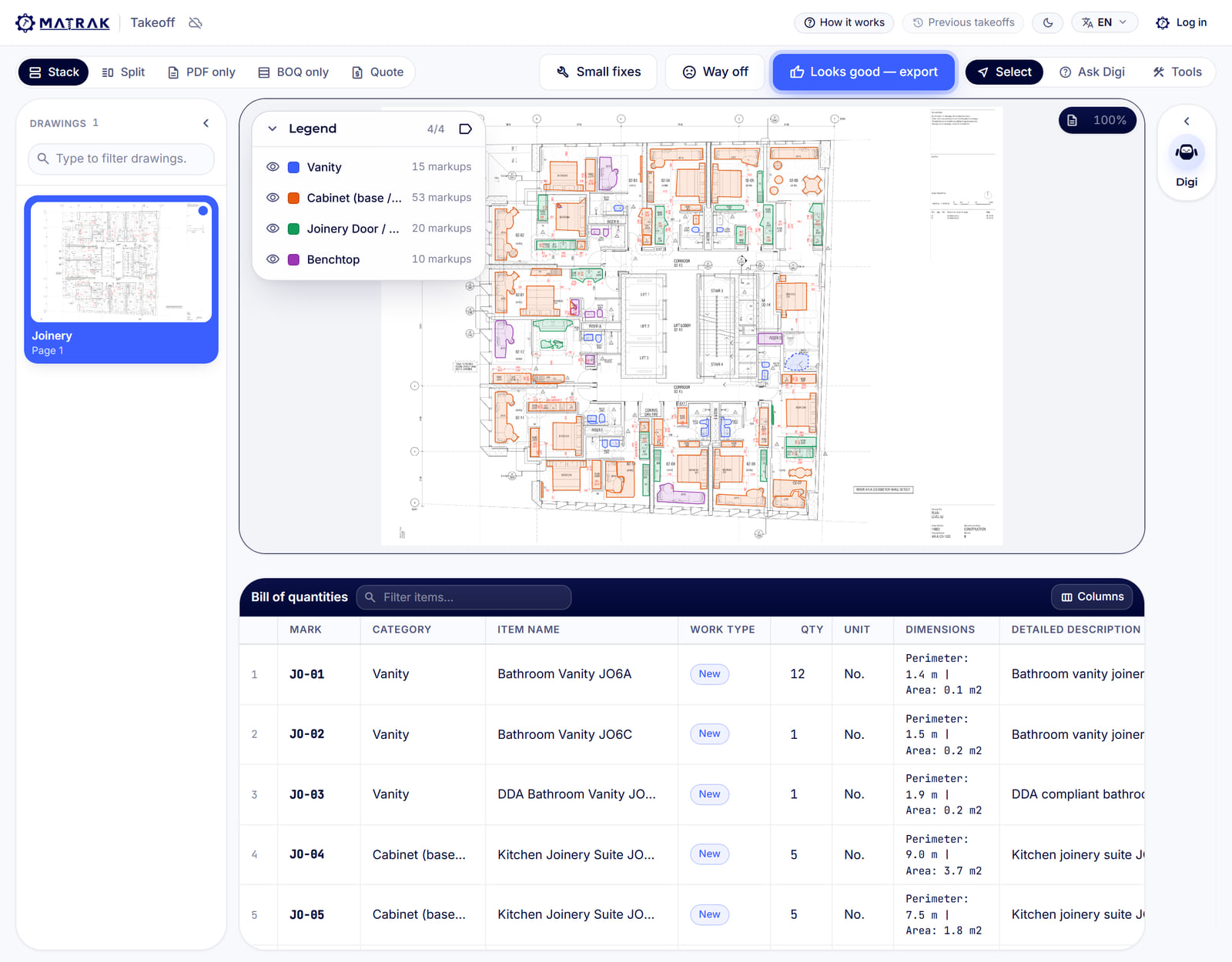
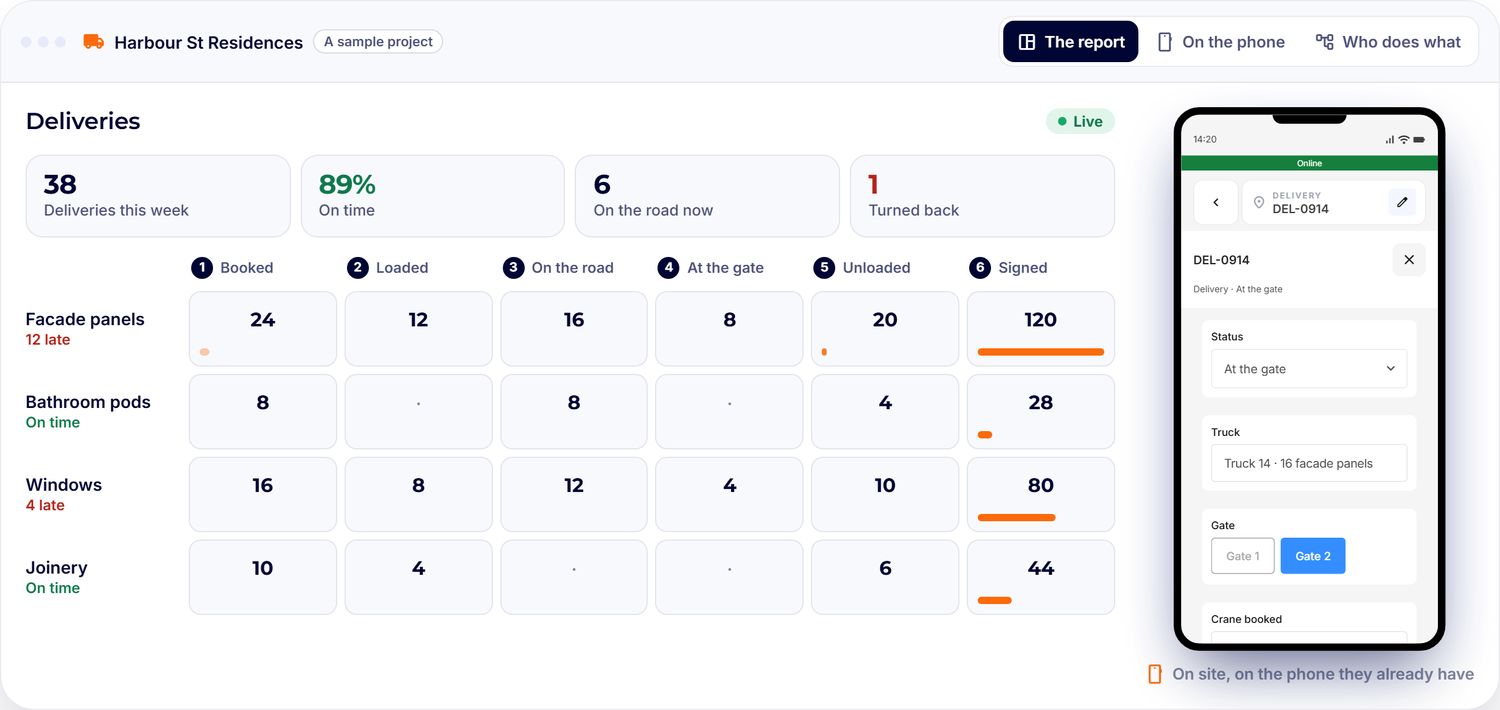
How Matrak does it. Matrak is not a blank diary page. Its Progress module gives you progress that updates itself from the site: as trades complete tasks, checks and installs in the app, each change is recorded against its location with who made it and when, and photos are kept on every item and check. The live dashboard shows progress on every level, so the daily record of work done, inspections and deliveries builds itself and your diary entry can stick to weather, delays and instructions. Progress is $12,000 for one project for a year, or from $96K a year for every project (A$, plus GST).
Why it is less work. The project is set up from your drawings, the same drawings that drive AI takeoff, supply chain and quality, so deliveries, installs and sign-offs land on one record. Matrak integrates with Procore, Aconex and Autodesk, so the drawings are fetched with nothing to download and new revisions are picked up as they land. Your own staff are free. Every change is kept in a full audit history, whether a person or the AI made it.
Frequently asked questions
What is a site diary in construction?
It is a daily written record of what happened on site: weather, labour, plant, work done, deliveries, delays, instructions, inspections and safety, kept by the site manager or supervisor.
Is a site diary a legal requirement?
A diary as such is usually a contract or company requirement, not something an Act names, though some of what it holds (such as safety records) is required by law. Many contracts require daily records, and they are valuable evidence in a dispute. Check your contract.
Who should write the site diary?
The person running the site that day, usually the site manager or supervisor. Subcontractor supervisors should keep their own for their own work.
How long should site diaries be kept?
Keep them for at least as long as claims can be made on the project, which can be many years after completion. Check your contract and get advice on the limitation periods in your state.
Can a site diary be digital?
Yes. A digital diary is easier to search and share and can attach photos with a time and location. What matters is that entries are made on the day and that changes are tracked.
Is there a free construction site diary template?
Yes. Copy the site diary template table on this page into a spreadsheet or a notebook, and keep the same headings every day so entries can be compared.