A construction procurement schedule is a list of everything a project has to buy, with the date each item is needed on site and every date that has to be hit before then: supplier appointed, shop drawings submitted and approved, order placed, made, shipped and delivered. It is worked backwards from the construction programme, so you can see today which orders are already late.
It is sometimes called a procurement programme, a procurement register or a long-lead schedule. In North America it is the procurement log for construction materials. For the wider topic see what construction procurement is.
What goes in a procurement schedule?
- The package or item and the trade it belongs to.
- The supplier or subcontractor, once appointed.
- Date required on site, taken from the construction programme, by level or zone where deliveries are staged.
- Lead time: design and shop drawings, approval, manufacture, shipping and customs, delivery to site.
- The dates that fall out of that: appoint by, submit by, approve by, order by, ship by.
- Who is responsible for each step.
- Status, and how many days of float are left.
How do you work out the order-by date?
Procurement schedule planning starts from the day the item must be on site. Subtract each step from it. Worked example for a unitised facade made overseas. The durations are an example only, so get real lead times in writing from your supplier.
| Step | Duration | Date |
|---|---|---|
| Required on site (from the programme) | 1 March 2027 | |
| Shipping, customs and delivery | 6 weeks | Leaves the factory by 18 January 2027 |
| Manufacture | 12 weeks | Released for production by 26 October 2026 |
| Shop drawing review and approval | 3 weeks | Shop drawings submitted by 5 October 2026 |
| Shop drawings prepared | 4 weeks | Supplier appointed by 7 September 2026 |
| Total lead time | 25 weeks |
If today is after 7 September and the supplier is not appointed, the facade is already late, six months before anyone on site would notice. That is the whole point of the schedule. Add a buffer for factory shutdowns, re-submissions of shop drawings and port delays.
Want to see every product from shop drawing to installed, across every company, without ringing a supplier? That is what Matrak Supply chain does, starting from your drawings.
Procurement schedule template
| Item | Supplier | Required on site | Lead time | Order by | Shop drawings | Status | Float |
|---|---|---|---|---|---|---|---|
| Unitised facade, levels 1 to 5 | Facade Co | 1 Mar 2027 | 25 weeks | 7 Sep 2026 | Submitted | In production | 0 days |
| Lift cars and equipment | Lift Co | 15 Feb 2027 | Approved | Ordered | |||
| Main switchboard | Electrical subcontractor | 30 Nov 2026 | Under review | Not ordered | |||
| Precast panels, core walls | Precast Co | 12 Oct 2026 | Approved | Casting | |||
| Bathroom pods, levels 1 to 8 | Pod Co | 18 Jan 2027 | Sample pod approved | In production | |||
| Joinery, apartments | Joinery Co | 22 Mar 2027 | Not started | Not ordered |
Fill the blank cells from your own suppliers' quotes. Sort the schedule by order-by date, not by trade, so the next decision is always at the top.
Which items are usually long-lead?
Long-lead items are the ones whose lead time is longer than the time between awarding the trade and needing the item on site. They vary by project and by market, but these are the usual suspects on a commercial or apartment building:
- Facade systems, curtain wall and special glass.
- Lifts and escalators.
- Switchboards, generators, transformers and other major electrical plant.
- Mechanical plant such as chillers and air handling units.
- Precast concrete and structural steel, which need shop drawings and a fabrication slot.
- Bathroom pods and other prefabricated modules.
- Joinery, stone and imported finishes or FF&E.
- Anything that needs a sample or a test before it can be made.
How do you track an item from shop drawing to site?
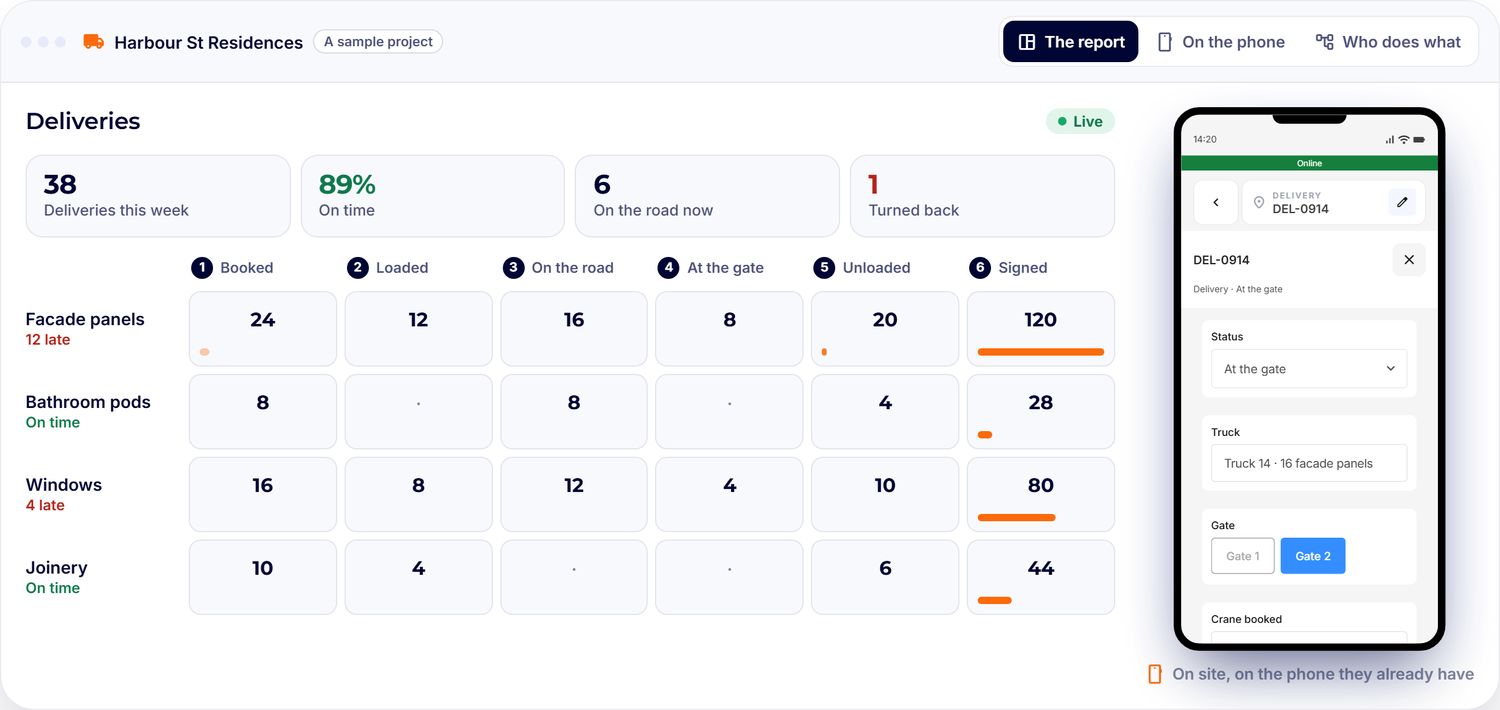
The schedule tells you when things should happen. Tracking tells you whether they did. Give each item or batch a status that moves through the same steps: shop drawing submitted, approved, in production, made and inspected, dispatched, delivered, installed. Then ask the companies doing the work to update it, at the factory and at the gate, so the builder is not ringing around for news. QR codes on each item make that update a scan. For the detail see the essential guide to material tracking.
What are the common mistakes with procurement schedules?
- Built once at the start and never updated. The programme moves, so the required dates move.
- Lead times from memory. Get them in writing with each quote, and ask what they assume (approved drawings by when?).
- Forgetting approvals. Shop drawing review, samples and tests often take longer than making the item.
- Tracking the order, not the item. 'Ordered' says nothing about whether level 3's panels have been made.
- No link to design changes. A drawing revision after approval restarts the clock.
- Delivering too early. Materials sitting on site get damaged, lost and moved three times. Sequence deliveries to the install.
Related guides: bill of quantities, construction variations and the construction site diary.
Your procurement tracker in Matrak
How Matrak does it. Matrak's Supply chain module tracks every product from shop drawing to installed, across every company on the job. Suppliers, manufacturers and installers update the status of each item themselves, often by scanning its QR code, and you load your programme so every product has a date. Supply chain is $30,000 for one project for a year, or from $96K a year for every project, with 5 supplier companies and 25,000 items included. It brings together Manufacturing, Installation, Inventory and Logistics for less than buying the four one by one (A$, plus GST).
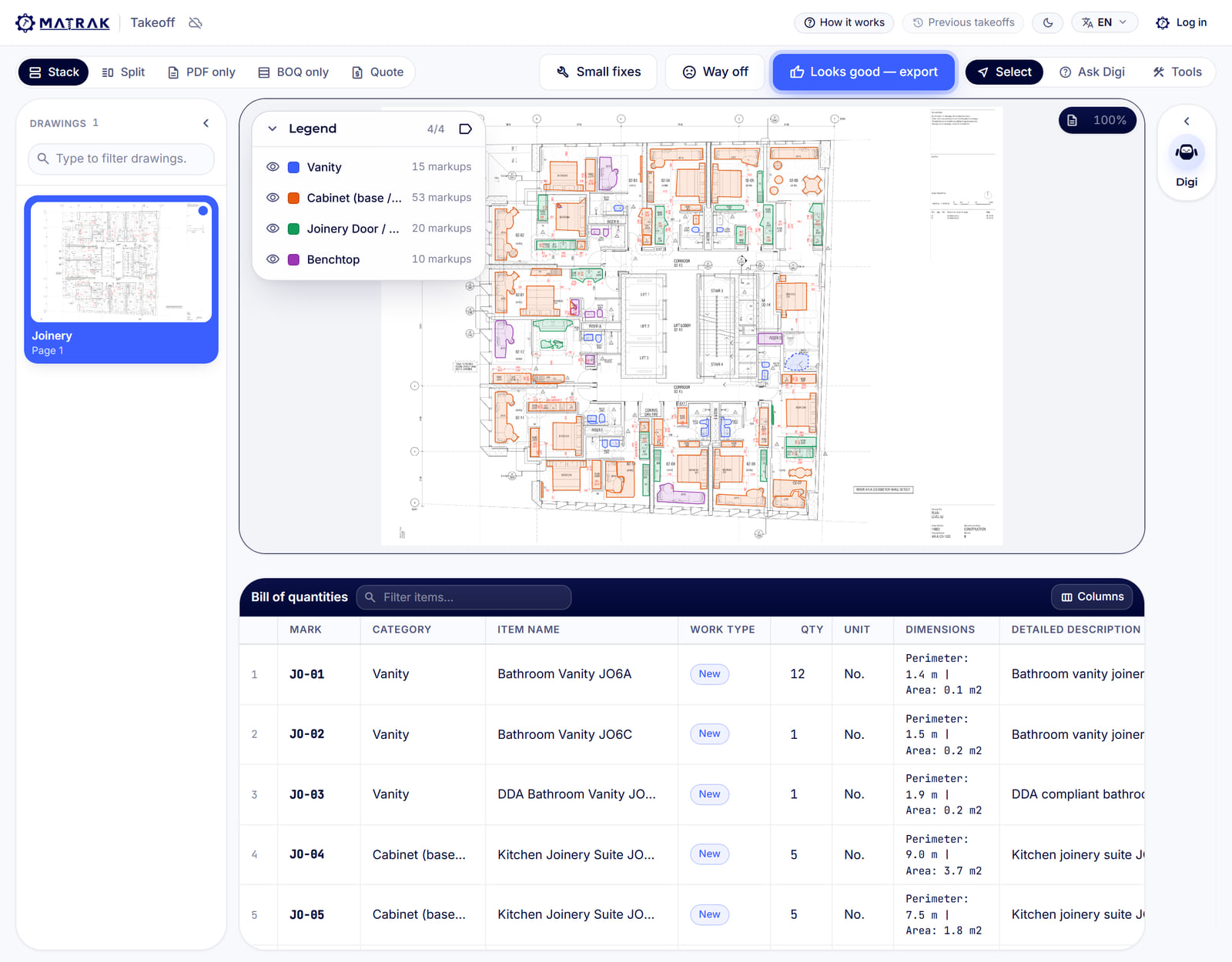
It starts from your drawings. AI Takeoff measures the job and links the bill to your own product, price and parts lists, so the list of what to buy and track is made for you, and the QR codes are made from the same drawings. Matrak integrates with Procore, Aconex and Autodesk, so the drawings are fetched with nothing to download and new revisions are picked up as they land. Every change is kept in a full audit history, whether a person or the AI made it.
Frequently asked questions
What is a procurement schedule in construction?
It is a list of everything the project must buy, with the date each item is needed on site and the dates for appointing the supplier, approving shop drawings, ordering, making and delivering it.
What is a long-lead item?
An item whose total lead time, from design and approval through manufacture and shipping, is long enough that it must be ordered early, often before the trade it belongs to starts on site.
Who is responsible for the procurement schedule?
The head contractor's project or contracts team usually owns it, with input from the site team for required dates and from each subcontractor and supplier for lead times.
How is a procurement schedule different from a construction programme?
The programme shows when work happens on site. The procurement schedule works backwards from those dates to show when each item must be approved, ordered and made so that it arrives in time.
How often should a procurement schedule be updated?
Review it weekly on an active project, and whenever the construction programme or the design changes. An out-of-date schedule gives false comfort.
Sources
Last reviewed 18 November 2026. This guide is general information for people working in construction. It is not legal or contract advice. Check your own contract and the current legislation, or ask a construction lawyer, before you rely on it.