A bill of quantities (BOQ) is a document that lists every item of work in a construction project with its description, unit and measured quantity, so that it can be priced. Tenderers fill in a rate against each line, and the totals become the tender price. Because everyone prices the same quantities, a BOQ lets a client compare tenders like for like, and it later becomes the basis for valuing progress claims and variations.
In Australia a bill of quantities for building construction is traditionally prepared by a quantity surveyor from the drawings and specification, following the Australian and New Zealand Standard Method of Measurement of Building Works (ANZSMM), available from the Australian Institute of Quantity Surveyors. Subcontractors also build their own trade BOQ every time they price a job.
What is in a bill of quantities?
- Preliminaries. Site set-up, supervision, plant, insurances: costs that are not tied to one item of work.
- Measured work. The main part, grouped by trade or element, with one line per item.
- Provisional sums and prime cost items. Allowances for work or products not yet fully defined.
- Summary. The trade totals collected into one tender sum.
Each measured line has an item reference, a description precise enough to price, a unit (m, m2, m3, no., t, item), a quantity, a rate and an amount.
Example bill of quantities: internal partitions
| Item | Description | Unit | Qty | Rate | Amount |
|---|---|---|---|---|---|
| P1 | Steel stud partition, 92 mm studs at 600 centres, one layer 13 mm plasterboard each side, 2,700 mm high | m2 | 211 | ||
| P2 | As P1 but fire rated, two layers 13 mm fire-grade plasterboard each side, to underside of slab | m2 | 84 | ||
| P3 | Wet area partition, 92 mm studs, 6 mm fibre cement sheet one side, 13 mm plasterboard other side | m2 | 56 | ||
| P4 | Acoustic insulation batts, 75 mm, to partitions P1 and P2 | m2 | 295 | ||
| P5 | Extra over for door opening in partition, 920 x 2,040 mm, including head and jamb studs | no. | 12 | ||
| P6 | Sealant to perimeter of fire rated partitions | m | 62 | ||
| Total for internal partitions, carried to summary |
The Rate and Amount columns are left for the tenderer. Once the rates are in, it is a priced bill of quantities. The quantities are an example for one floor. Notice that each description says what is included, because the rate has to cover everything in it.
Need a BOQ from a set of drawings by tomorrow? Matrak AI Takeoff measures the whole project for you and marks every item on the sheet it came from. It is $89 a trade with no subscription, and can save over $2,000 of estimating labour on one project.
BOQ vs BOM vs schedule of rates: what is the difference?
| Bill of quantities (BOQ) | Bill of materials (BOM) | Schedule of rates | |
|---|---|---|---|
| Lists | Items of finished work, measured in place | The materials and parts to buy or make | Rates for items of work, with no fixed quantities (or estimates only) |
| Example line | 211 m2 of stud partition, lined both sides | 148 sheets of plasterboard, 520 studs, 9,000 screws | Stud partition, lined both sides: $ per m2 |
| Includes labour? | Yes, in the rate | No, materials only | Yes, in the rate |
| Used for | Tendering, valuing claims and variations | Ordering, manufacturing and tracking materials | Work where the scope is not known up front, such as maintenance |
| Who prepares it | Quantity surveyor or estimator | Estimator, supplier or manufacturer | Client or quantity surveyor |
How do you build a bill of quantities from drawings?
- Collect the documents. The current revision of every drawing, the specification, schedules and any addenda.
- Set the structure. Break the job into trades or elements, and decide the measurement rules (the ANZSMM, or your own for a trade BOQ).
- Do the takeoff. Count, measure lengths and measure areas from the drawings, item by item. See our guide to quantity takeoff.
- Write the descriptions. Each line must say enough to be priced: material, size, fixing, finish, height or location where it changes the price.
- Add preliminaries, provisional sums and prime cost items.
- Check it. Compare totals against floor areas, check typical floors were multiplied correctly, and have someone else spot-check the biggest lines.
- Record the drawing revisions it was measured from, so a later change can be priced as a variation.
What are the common mistakes in a bill of quantities?
- Measured from an old revision. The single most expensive mistake. Record the revision on the BOQ.
- Items missed between trades. Sealants, flashings, fire stopping and builder's work often fall in the gaps.
- Descriptions too vague to price. 'Partition' is not enough. The rate depends on the lining, height and rating.
- Wrong unit. Measuring skirting in m2 or membrane in metres.
- Double counting. The same item measured from the plan and again from a detail or schedule.
- No allowance stated for waste and laps. Say whether quantities are net as fixed (the usual rule) and let the rate carry the waste.
Is there a bill of quantities template?
The example table above is the BOQ template: Item, Description, Unit, Qty, Rate, Amount, grouped by trade, with a summary page that adds the trade totals, preliminaries and provisional sums. Keep one more column for the drawing reference, so every quantity can be traced back to a sheet. Most estimators keep the bill of quantities in Excel, one tab per trade. Related guides: progress claims, construction variations, the best AI takeoff software and the best construction estimating software in Australia.
Get a BOQ from your drawings automatically
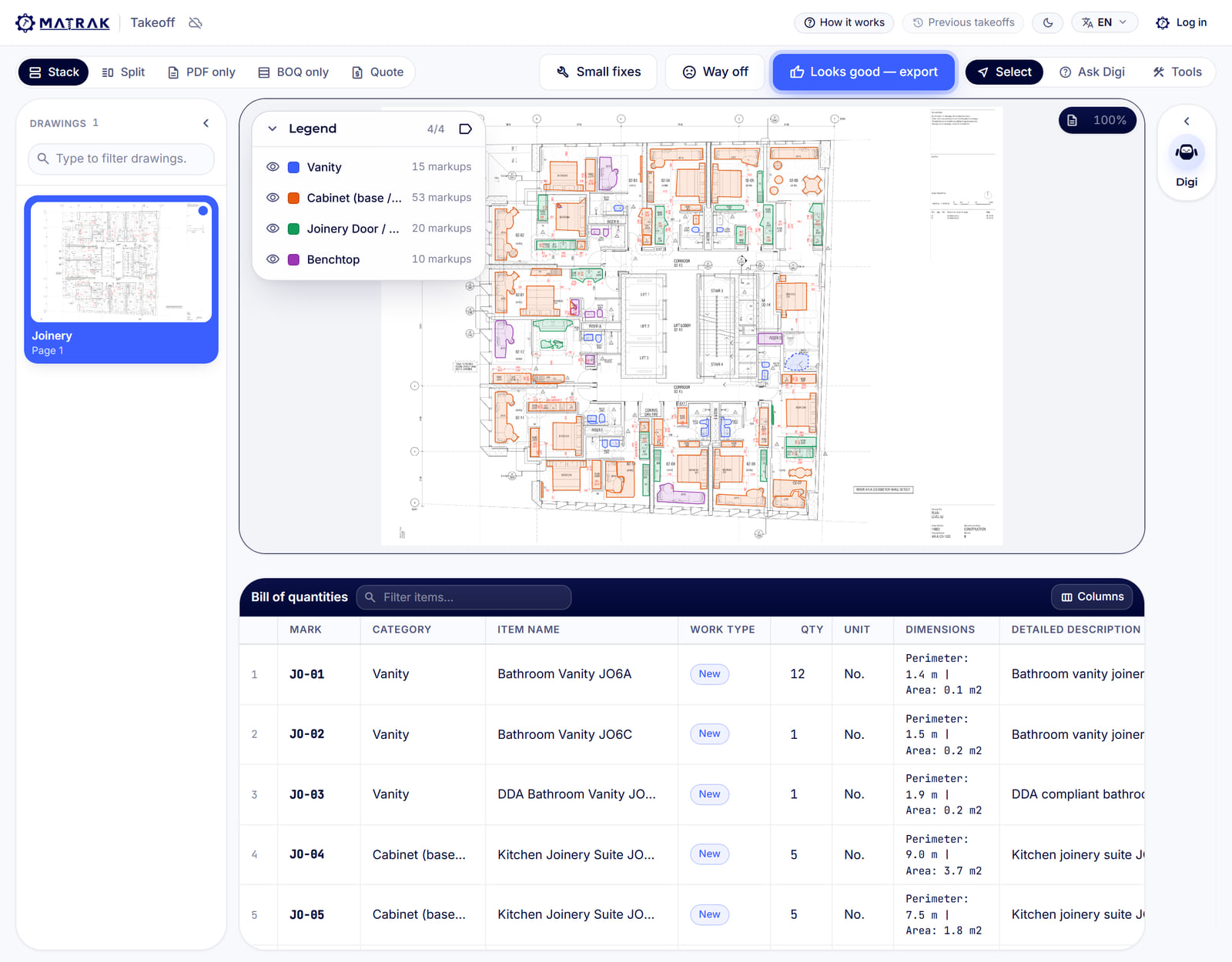
How Matrak does it. Matrak AI Takeoff turns your drawings into a bill of quantities, with every item marked up. Drop in your PDFs, pick the trade and say anything to include or leave out. Every line is marked on the sheet it came from, so you can see what was counted, fix it, and export it. It is pay as you go: $89 a credit with no subscription, or from $65 a credit on a monthly plan. One credit reads one trade, however many drawings go in together (A$, plus GST).
Why estimators switch. Measuring one project by hand can take over $2,000 of an estimator's labour. One AI takeoff is $89 a trade, so it can save over $2,000 of estimating labour on one project. The AI does the first pass and a person checks it. It runs over 1,000 documents in one pass, so the whole project is measured at once, and it cross-references between drawings, so the same item on a plan, an elevation and a schedule is counted once. It is built on a library of over 90 trades, fetches drawings from Procore, Aconex or Autodesk, and can run by itself as new drawings land. The bill and the quote come back as working Excel files in your own format, with fully marked-up drawings, and the same bill goes on to drive supply chain, quality and progress.
Frequently asked questions
BOQ full form: what does BOQ stand for?
The full form of BOQ in construction is bill of quantities. It is sometimes written BoQ or BQ. It lists every item of work in a project with its unit and measured quantity so it can be priced.
Who prepares a BOQ in construction?
On larger projects a quantity surveyor prepares it for the client before tender. Where no BOQ is issued, each builder and subcontractor prepares their own from the drawings in order to price the job.
What is the difference between a BOQ and an estimate?
The BOQ is the list of measured quantities. An estimate is the BOQ with rates applied, plus preliminaries, margin and risk. The same BOQ can produce different estimates from different tenderers.
Does a bill of quantities form part of the contract?
It depends on the contract. In some contracts the BOQ is a contract document and errors in it are adjusted. In others it is issued for information only and the tenderer carries the risk. Check the tender conditions.
How long does it take to prepare a bill of quantities?
By hand or on screen, a trade BOQ can take from a few hours to several days depending on the size of the job. AI takeoff tools can produce a first measured bill for one trade in well under an hour, which an estimator then checks.
Bill of quantities meaning, in plain words
A bill of quantities in construction is the measured list of everything to be built, ready to price. That is the BOQ meaning in construction wherever you work, and the usual bill of quantities definition: each item of work, its unit and its quantity.
Sources
- Australian Institute of Quantity Surveyors: publications, including the ANZSMM
- Matrak: construction takeoff and estimating
Last reviewed 18 November 2026. This guide is general information for people working in construction. It is not legal or contract advice. Check your own contract and the current legislation, or ask a construction lawyer, before you rely on it.