A variation is a change to the work a contractor agreed to do under a construction contract: something added, removed, or done differently from the contract drawings and specification. Because the price and time in the contract were based on the original scope, a variation usually changes one or both. Americans call it a change order.
Most arguments about variations are not about whether the work changed. They are about whether it was instructed, whether notice was given in time, and how it is valued. This guide covers the process that avoids those arguments. It is general information, not legal advice.
What counts as a variation?
- A design change. A revised drawing adds a wall, moves a door or changes a finish.
- A client request. Extra power points, an upgraded benchtop.
- Something found on site. Rock, contamination or an existing service that the contract documents did not show, where the contract treats it as a variation.
- A change required by an authority after the contract was signed.
- Omitted work. Scope taken out is also a variation, with a credit.
What does not count: work that was always in your scope but missed in your price, or fixing your own defects. Whether a design development change is a variation under a design and construct contract depends on the contract.
What is the variation process?
- Spot the change. Compare each new drawing revision with the one you priced. Do not rely on revision clouds alone.
- Give notice. Send a variation notice that tells the other party in writing that you consider it a variation, within the time your contract sets. Late notice can cost you the claim.
- Get a written instruction before doing the work, from the person the contract authorises.
- Price it, showing quantities, rates and any time impact.
- Get approval of the price, or a direction to proceed with the value to be agreed.
- Do the work and keep records: labour, materials, photos and site diary entries.
- Claim it in your next progress claim, listed separately with its approval reference.
For home building, the law in some states adds its own rules. In New South Wales, for example, the government's guidance is that variations must be in writing, and for larger contracts signed by both the owner and the contractor. Check the rules for your state and contract type.
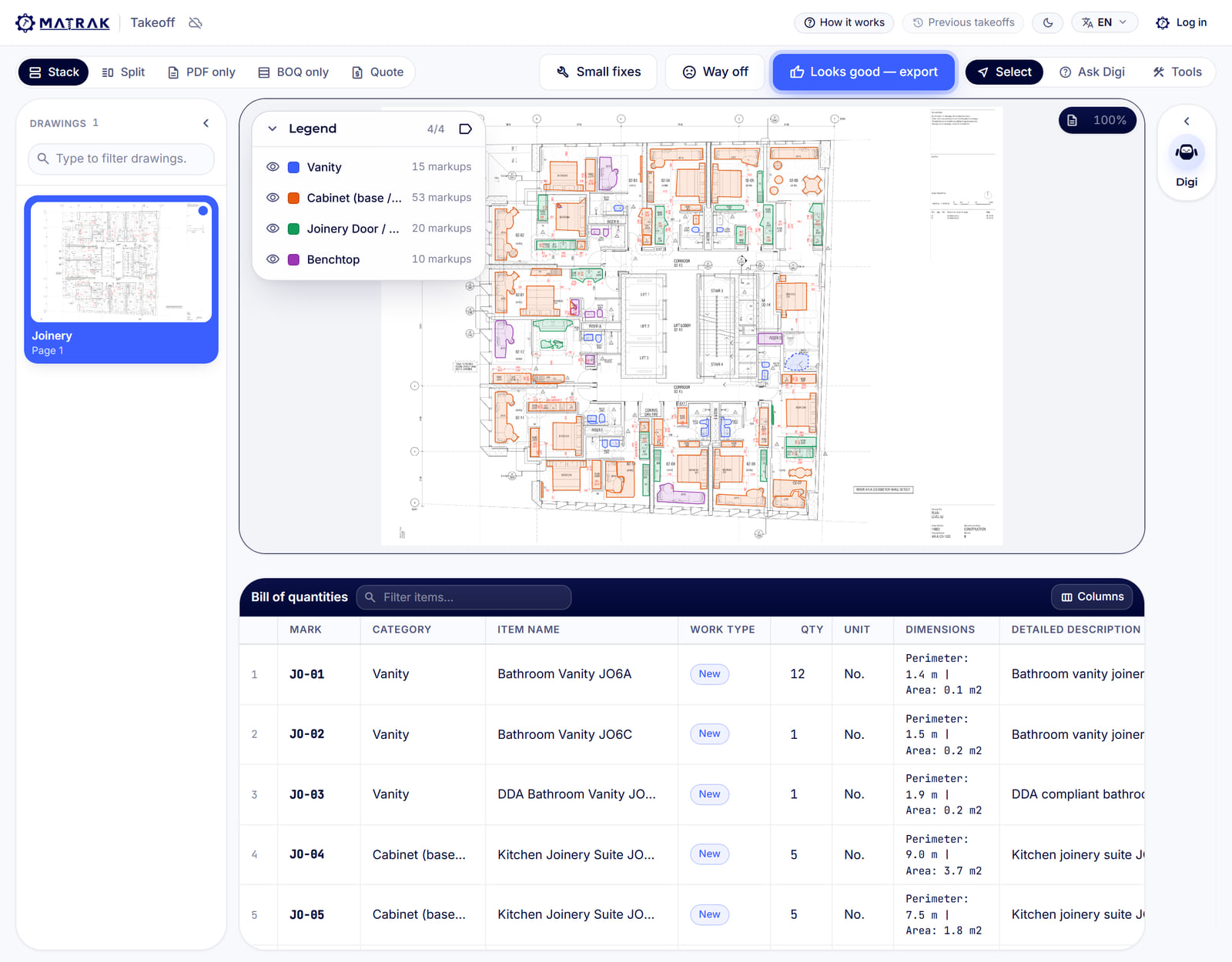
Is finding what changed between revisions eating your week? Matrak Variations re-measures a new drawing revision against the last one and shows what changed, in quantities and in dollars.
Variation register template
| No. | Description | Source | Date raised | Notice given | Value claimed | Time claimed | Status | Approved value | Claimed in |
|---|---|---|---|---|---|---|---|---|---|
| V01 | Extra bulkheads, level 1 kitchens | Drawing A-201 rev D | 2 Nov | 3 Nov | $8,000 | 0 days | Approved | $8,000 | Claim 4 |
| V02 | Change partition P1 to fire rated, level 2 corridor | Architect's instruction 14 | 9 Nov | 9 Nov | $5,400 | 1 day | Priced, awaiting approval | ||
| V03 | Delete feature ceiling, lobby | Drawing A-310 rev C | 12 Nov | 12 Nov | -$3,200 | 0 days | Approved | -$3,200 | Claim 5 |
| V04 | Extra door, unit 5.03 | Site instruction (verbal), confirmed by email | 18 Nov | 18 Nov | To be priced | Awaiting written instruction |
One row for each variation, including the ones you think are small and the ones that are credits. The register should always answer three questions: what has been approved, what is still being argued, and what has been paid. It is also your record of each construction variation approval: who approved it, when and for how much.
How do you price a change from a revised drawing?
Measure the revised drawing the same way you measured the original, then price the difference. Where the contract or your bill of quantities has rates, use them. Worked example, with rates that are examples only:
| Item | Rev C qty | Rev D qty | Change | Rate | Amount |
|---|---|---|---|---|---|
| Partition P1 | 211 m2 | 229 m2 | +18 m2 | $95 per m2 | $1,710 |
| Door openings | 12 no. | 14 no. | +2 no. | $420 each | $840 |
| Bulkhead | 62 m | 56 m | -6 m | $110 per m | -$660 |
| Net change | $1,890 | ||||
| Margin at 10%, if the contract allows | $189 | ||||
| Variation price, before GST | $2,079 |
Show the omissions as well as the additions. A variation that only lists the extras invites a fight. And state the time effect, even if it is nil. For how to measure see quantity takeoff.
What are the common mistakes with variations?
- Doing the work on a verbal instruction. Confirm it in writing the same day, to the person authorised under the contract.
- Missing the notice period. Many contracts bar a claim if notice is late.
- Not noticing the change. A revision issued 'for construction' with unclouded changes gets built for free.
- Lump-sum prices with no breakdown. They are slow to approve. Show quantities and rates.
- Claiming money but not time. If the change delays you, say so at the same moment.
- No register. Variations agreed on site and forgotten by the final account.
- Building from the old drawing. The cost of a missed revision is rework, not just a lost claim.
Comparing tools for measuring changes? See the best AI takeoff software and the best construction estimating software in Australia.
Variations and revisions in Matrak
How Matrak does it. Matrak's Variations module re-measures a new drawing revision against the last one and shows what changed, so you know what a change costs before the argument starts. It is $750 a month, with 10 AI credits. The Revisions module finds new drawing revisions and compares them for you, so nobody builds off the old drawing. It is $400 a month, with 5 AI credits (A$, plus GST). Variations is in early access: you can price it and add it to your Matrak today.
Why nothing gets missed. An AI agent watches your document system, Procore, Aconex or Autodesk, and runs as new drawings land, on approved versions only if you choose, so a revision is re-measured without anyone downloading it. The re-measure uses the same AI takeoff the job was priced on, and Matrak's AI design management stops a late drawing from disrupting delivery. Every change is kept in a full audit history, whether a person or the AI made it.
Frequently asked questions
What is a variation in a construction contract?
It is a change to the scope of work agreed in the contract: work added, omitted or changed. It usually leads to a change in the contract price, the time for completion, or both.
Does a variation have to be in writing?
Most contracts require a written instruction, and home building laws in some states require variations to be in writing. Even where it is not strictly required, never rely on a verbal instruction alone.
Is a variation order a change order?
Yes. A variation order is the written instruction for a change, the term used in Australia, New Zealand and the UK. Change order is the North American term. Under NEC contracts, common in the UK, a change like this is dealt with as a compensation event.
How is a variation valued?
Usually by the rates in the contract or bill of quantities where they apply, otherwise by reasonable rates or agreed prices, plus the margin the contract allows. The contract sets the order of these methods.
Can a contractor refuse to do a variation?
It depends on the contract. Most allow the principal to direct variations within the general scope of the work, and the contractor must carry them out and be paid. Changes outside that scope may need agreement.
Is there a variation order template?
A variation form needs the project and contract, a number and date, the change described with its drawing references, the price build-up, the time effect and a signature from each party. Keep one construction variation template for the whole job and log each one in the register above. If your contract comes with its own contract variation template, use that.
Sources
Last reviewed 18 November 2026. This guide is general information for people working in construction. It is not legal or contract advice. Check your own contract and the current legislation, or ask a construction lawyer, before you rely on it.