An inspection and test plan template is a table with one row for each check in a trade's work, and columns for the pass mark, the type of inspection (hold point, witness point or check), who signs and what record is kept. Copy the tables below into your own spreadsheet or quality system, then change the criteria to match your drawings and specification.
These three ITP templates for construction cover trades where missed checks are costly: an in-situ concrete pour, internal wet area waterproofing and passive fire stopping. New to ITPs? Start with what an ITP is in construction.
What columns does an ITP template need?
| Column | What goes in it |
|---|---|
| No. | A line number, so a defect or NCR can point to it |
| Activity | The step, in the order it is built |
| Acceptance criteria | The pass mark and its source: drawing, spec clause, data sheet or standard |
| Type | H = hold point, W = witness point, C = check by the subcontractor |
| Signed by | Subcontractor (SC), head contractor (HC), engineer (ENG), certifier or surveyor (CERT) |
| Record | The evidence kept: checklist, photo, test report, docket |
Every ITP form also needs a header: project, trade, the lot it covers (pour 14, unit 3.07 ensuite, level 5 east), the drawing revisions used, and the date it was approved.
ITP template: in-situ concrete pour
| No. | Activity | Acceptance criteria | Type | Signed by | Record |
|---|---|---|---|---|---|
| 1 | Set-out and levels | As the structural drawings, within the specified tolerance | C | SC, surveyor | Survey report |
| 2 | Formwork | Clean, tight, propped as the formwork design, release agent applied | C | SC | Checklist, photos |
| 3 | Reinforcement | Bar size, spacing, laps, cover and chairs as the drawings | H | ENG, HC | Engineer's inspection record |
| 4 | Cast-in items and penetrations | Sleeves, conduits, ferrules and starter bars in place and fixed | W | HC, services trades | Checklist, photos |
| 5 | Pre-pour release | Lines 1 to 4 signed, weather and pump access suitable | H | HC | Signed pre-pour |
| 6 | Concrete delivery | Mix, strength grade and slump as specified, checked on each docket | C | SC | Dockets, slump results |
| 7 | Test cylinders | Sampling at the specified frequency by an accredited lab | W | SC, lab | Sample register |
| 8 | Placing, compaction and finish | Vibrated, no cold joints, finish class as specified | C | SC | Photos |
| 9 | Curing | Method and period as specified | C | SC | Curing record |
| 10 | Strength results and stripping | Results meet the specified strength before stripping or stressing | H | ENG, HC | Lab reports |
ITP template: internal wet area waterproofing
| No. | Activity | Acceptance criteria | Type | Signed by | Record |
|---|---|---|---|---|---|
| 1 | Materials and applicator | Specified membrane system, applicator licensed where required | C | SC, HC | Data sheets, licence |
| 2 | Substrate | Clean, dry, falls to waste as drawn, penetrations fixed | H | HC | Checklist, photos |
| 3 | Primer, bond breakers, fillets | At every junction and penetration, as the data sheet | C | SC | Photos |
| 4 | Membrane application | Coats, thickness, upturns and extents as the data sheet and drawings | W | SC, HC | Photos, batch numbers |
| 5 | Flood test | After full cure, for the specified period, no leaks | H | HC | Test record, photos |
| 6 | Release to tiler | All lines signed and defects closed | H | HC | Signed ITP |
ITP template: passive fire stopping to service penetrations
| No. | Activity | Acceptance criteria | Type | Signed by | Record |
|---|---|---|---|---|---|
| 1 | Approved systems | A tested system nominated for every penetration type, wall or floor type and required fire rating | H | HC, fire engineer | System register, test reports |
| 2 | Penetration ready | Opening size, annular gap and service type match the tested system | C | SC | Checklist |
| 3 | Installation | Product, depth and backing as the tested system, installed by a trained installer | C | SC | Photo before and after |
| 4 | Label and register | Each penetration labelled with a unique ID and logged with location, system and installer | C | SC | Penetration register |
| 5 | Inspection before cover-up | Sample or full inspection before ceilings and risers close | H | HC, certifier | Signed inspection |
| 6 | Handover | Register, photos and system data complete for every penetration | W | HC | Handover pack |
Rather not build these by hand? Matrak Quality builds your ITPs from your drawings, one for every room, pour or level, so the checklist is ready before the trade arrives.
How do you fill in an ITP template?
- Start from the spec, not the template. Read the specification section and the drawings for the trade, and change each acceptance criterion to the real clause, tolerance or data sheet.
- Set the hold and witness points with the head contractor. Add the mandatory inspections the certifier or engineer needs.
- Get it approved before work starts. An ITP approved after the first pour is a record of what you hoped happened.
- Decide the lot. One copy for each pour, room, riser or level. Name it so anyone can find it.
- Sign each line when it is checked. At the work, with the date, a name and a photo.
- Close it out. When every line is signed and any defects or NCRs are closed, the lot is released and the record goes in the handover pack.
What are the common mistakes with ITP templates?
- Using a template unchanged. A generic pass mark will not match your specification. The template is the layout, not the content.
- No link to the drawing revision. If the drawings change, the ITP has to change with them.
- Missing the lot. 'Level 3' is not enough for waterproofing. Record each wet area.
- No evidence column. A signature without a photo or test report is hard to defend two years later.
- No path for a failed check. Say what happens on a fail: fix and re-inspect, or raise a non-conformance report.
Related guides: quality assurance vs quality control, practical completion and the best construction quality management software.
Or have Matrak build your ITPs from your drawings
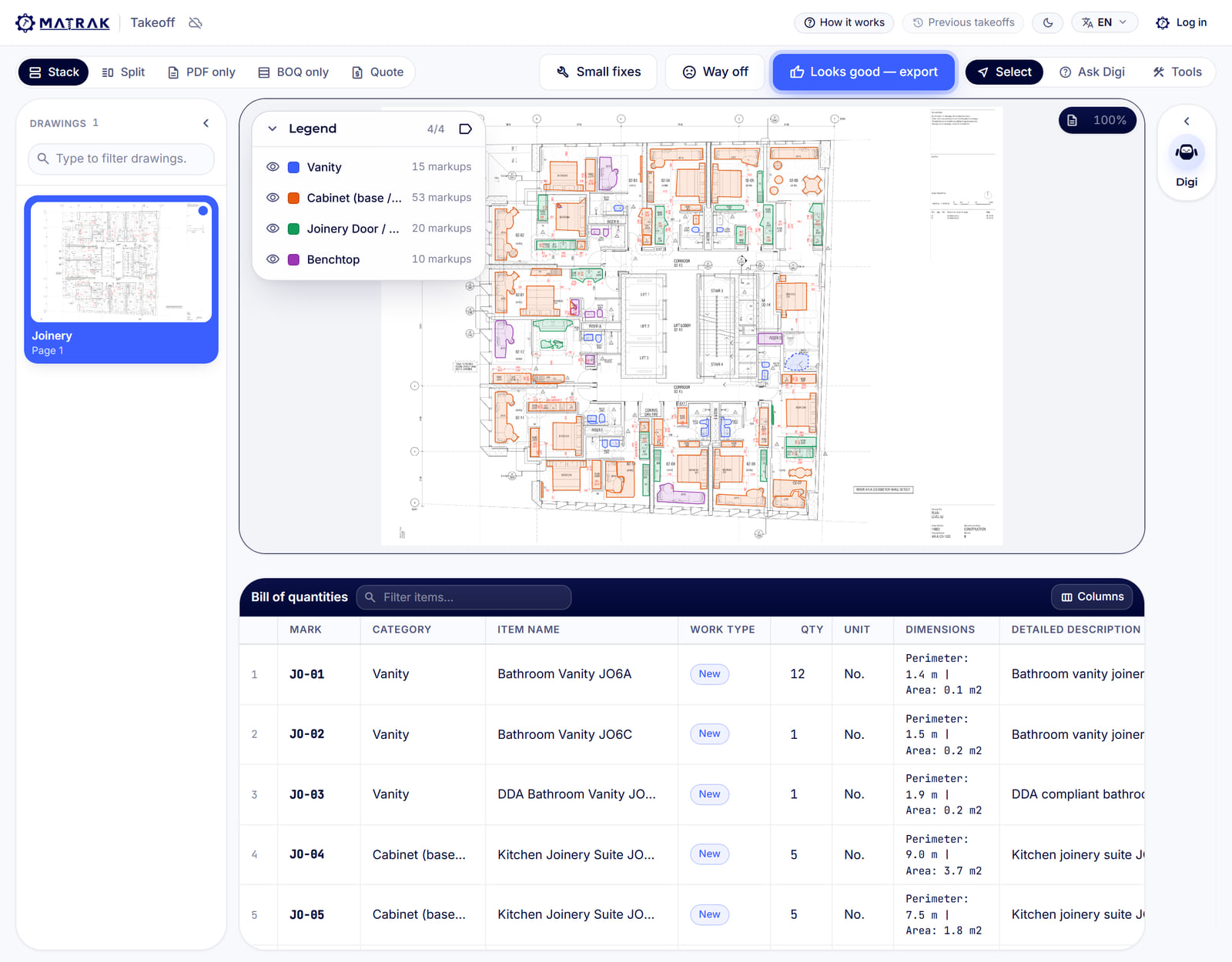
How Matrak does it. Matrak's Quality module builds your ITPs, inspections and sign-offs from your drawings. Each ITP is a checklist linked to the location or material it covers, filled in on the phone app (online or offline) with photos, and its status follows the checks by itself: In Progress once a check is answered, Issues as soon as one fails, Complete when every check passes. Hold points make work wait for the right sign-off and email the right people. Quality is $18,000 for one project for a year, or from $96K a year for every project, with 50 subcontractor companies included (A$, plus GST).
Why it is less work. The set-up is done for you from the drawings, and they are the same drawings that drive AI takeoff, supply chain and progress, so nothing is keyed in twice. Matrak integrates with Procore, Aconex and Autodesk, so the drawings are fetched with nothing to download and new revisions are picked up as they land. Your own staff are free. Every change is kept in a full audit history, whether a person or the AI made it.
Frequently asked questions
Is there a standard ITP template in Australia?
There is no single mandatory format. Most contractors use a table with activity, acceptance criteria, inspection type, who signs and the record kept. Government road and rail specifications publish their own hold point schedules, and many builders have a house format.
Can I use one ITP template for every project?
Use one layout, but rewrite the acceptance criteria for each project's drawings and specification. The checks for a post-tensioned slab are not the checks for a slab on ground.
How many ITPs does a project need?
One ITP for each trade or work package, then one completed record for each lot. An apartment building can easily have dozens of ITPs and thousands of completed records.
What is the difference between an ITP and an ITR or checklist?
The ITP is the plan. The inspection and test record (ITR), or checklist, is the filled-in form for one lot that proves the plan was followed.
Who approves an ITP?
The head contractor approves a subcontractor's ITP before work starts. Some contracts also need the client's superintendent or the engineer to review it.
Sources
- Matrak: quality tracking, how ITPs and checklists work in Matrak
- Acceptance criteria in these templates are a layout to copy. The real pass marks come from your drawings, specification, manufacturer's data sheets and the Australian Standards your contract cites.
Last reviewed 18 November 2026. This guide is general information for people working in construction. It is not legal or contract advice. Check your own contract and the current legislation, or ask a construction lawyer, before you rely on it.