An environmental product declaration (EPD) is an independently verified document that states the environmental impact of a product over its life cycle, worked out to a published standard. In construction it is where the embodied carbon figure for a product comes from: so many kilograms of CO2e per tonne, cubic metre or square metre.
EPDs work the same way in Australia, the UK, Canada, New Zealand and the US. They are Type III environmental declarations under ISO 14025, and for construction products they follow EN 15804 or ISO 21930.
What is in an environmental product declaration
- The product and who makes it. One manufacturer, or an industry group for an industry-average EPD.
- The declared unit. 1 tonne of reinforcing bar, 1 m3 of 40 MPa concrete, 1 m2 of panel.
- The life cycle stages covered. Modules A1 to D.
- The results table. Global warming potential (GWP) in kg CO2e, plus other indicators such as water use and waste.
- The rules it follows. The product category rules (PCR).
- Who checked it and until when. The programme operator, the independent verifier, the issue date and the expiry, usually five years on.
The life cycle stages, A1 to D
| Modules | Stage | What it covers |
|---|---|---|
| A1 to A3 | Product | Raw materials, transport to the factory, manufacture |
| A4 to A5 | Construction | Transport to site, installation and waste |
| B1 to B7 | Use | Maintenance, repair, replacement, energy and water in use |
| C1 to C4 | End of life | Demolition, transport, waste processing, disposal |
| D | Beyond the life cycle | Benefits of reuse, recovery and recycling, reported separately |
A1 to A3 is called cradle to gate, and it is the figure most embodied carbon sums use. Newer EPDs to EN 15804+A2 also report C1 to C4 and D for most products.
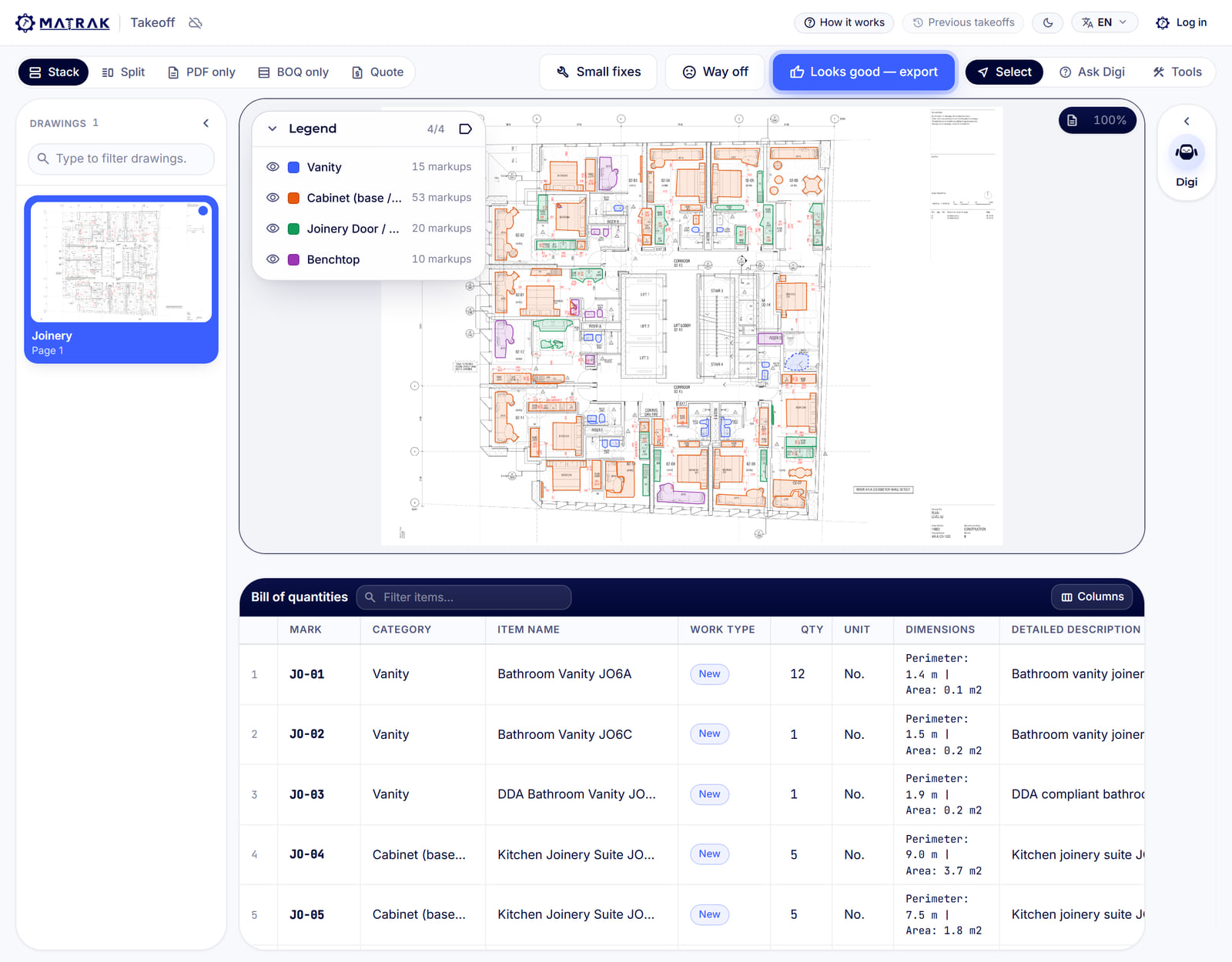
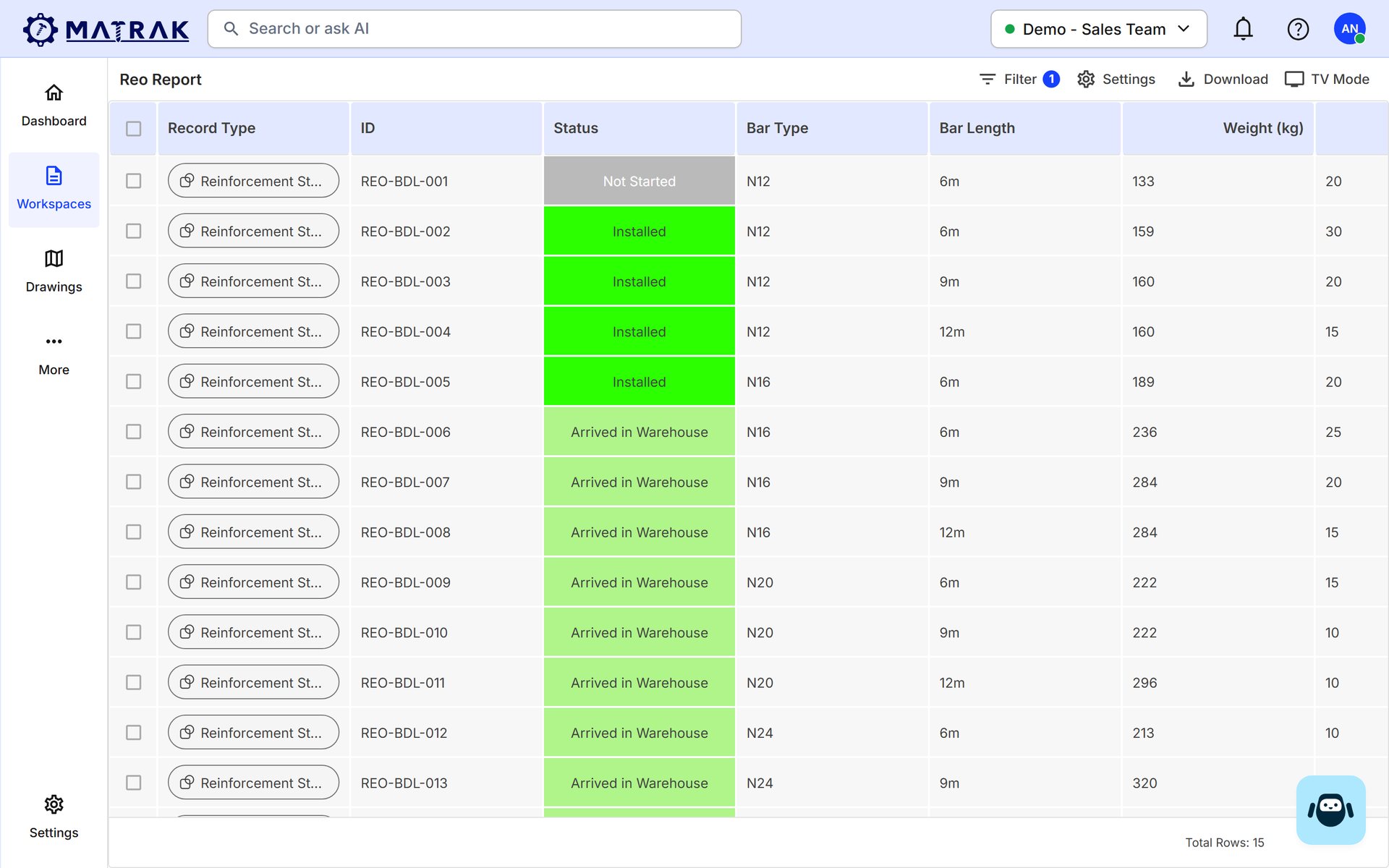
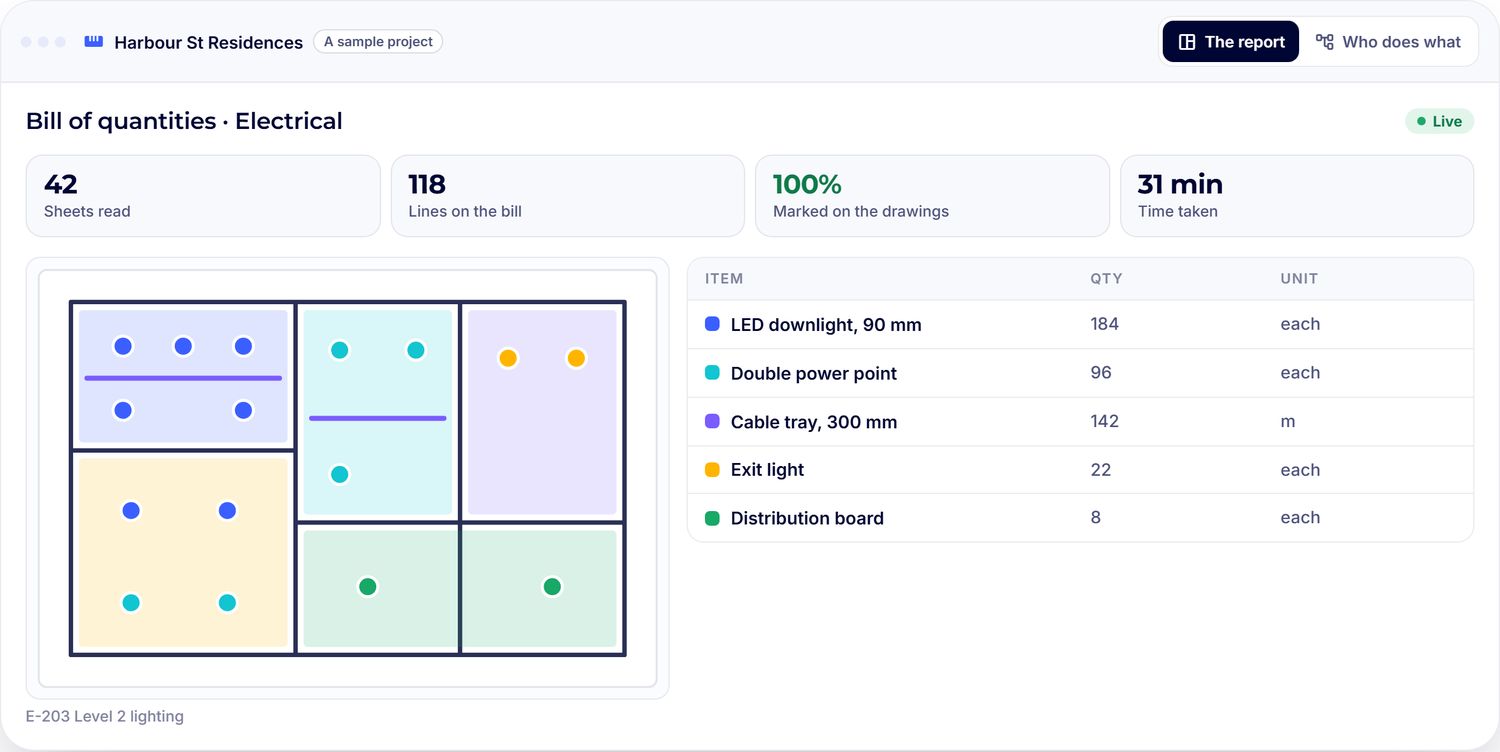
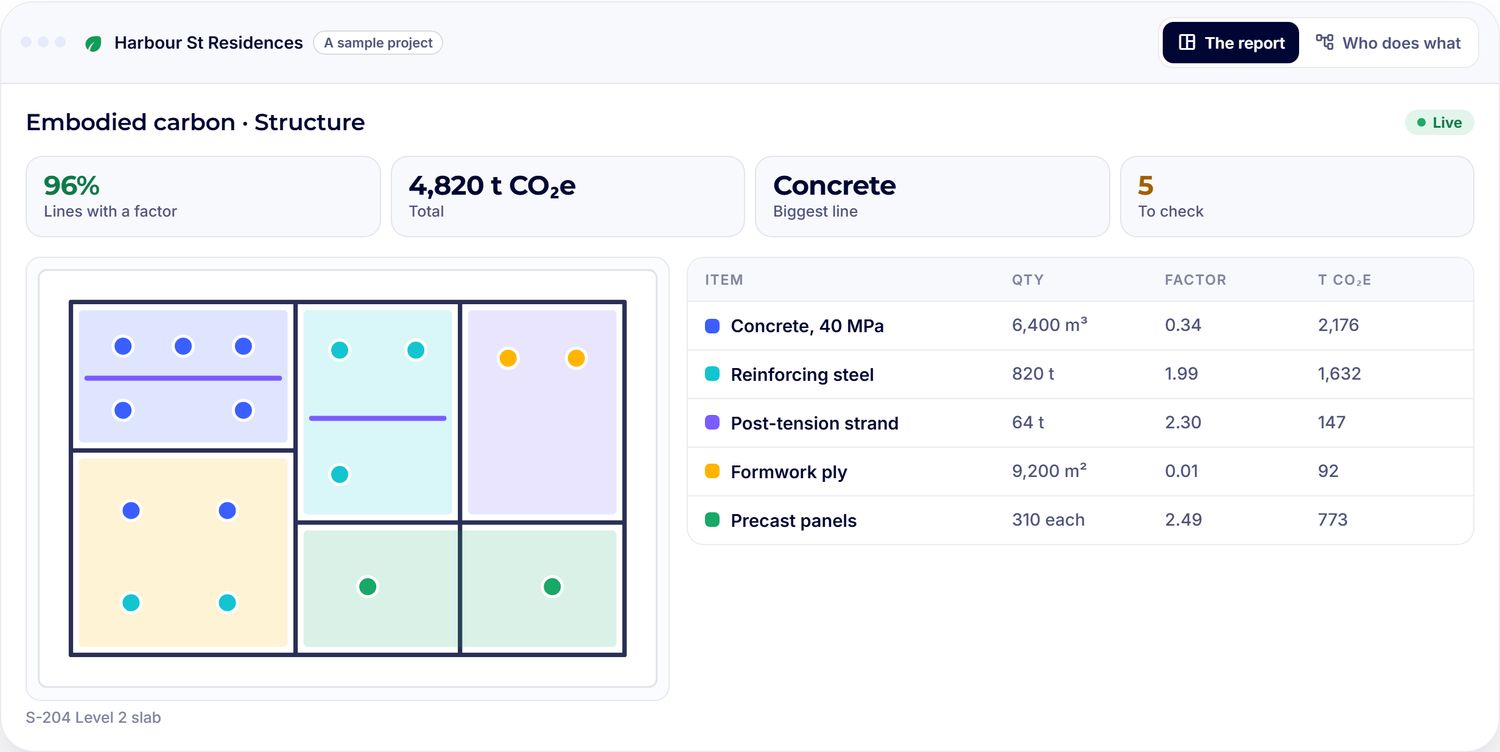
The carbon number arrives with the quantities, not weeks later. Matrak Carbon puts a carbon factor on every line of the bill measured off your drawings.
How to read an EPD in five checks
- Is it current? Check the expiry date.
- Is it your product? From the plant that will supply you. Product-specific beats industry-average.
- What is the declared unit? Convert it to the unit on your bill.
- Which modules are included? Compare A1 to A3 with A1 to A3.
- Which standard and PCR? Results to EN 15804+A1 and +A2 are not directly comparable. Only compare EPDs made to the same rules.
From EPD to embodied carbon: a worked example
Embodied carbon is quantity times factor. The factor comes from the EPD. The quantity comes from your bill of quantities. The factors below are made up for the example: use the ones on your suppliers' EPDs.
| Material | Quantity | Factor from the EPD, A1 to A3 | Embodied carbon |
|---|---|---|---|
| Concrete, 40 MPa | 850 m3 | 300 kg CO2e per m3 | 255 t CO2e |
| Reinforcing bar | 95 t | 1,500 kg CO2e per t | 142.5 t CO2e |
| Aluminium window framing | 12 t | 9,000 kg CO2e per t | 108 t CO2e |
| Total | 505.5 t CO2e |
Swap the reinforcing bar for one with an EPD of 1,000 kg CO2e per tonne and the job drops by 47.5 tonnes. That is the practical use of an EPD: choosing between real products on real numbers. More on the sum: embodied carbon in construction.
Where to find EPDs
- Australia and New Zealand: EPD Australasia.
- Worldwide: the International EPD System.
- Europe: national programmes in the ECO Platform, such as IBU in Germany.
- North America: programme operators such as UL Solutions and ASTM, searchable in the EC3 tool.
- The manufacturer. Ask for the EPD for the plant that will supply your job.
Common mistakes with EPDs
- An expired EPD.
- Comparing different units or different modules.
- An industry average where a product EPD exists. Or a product EPD for a product you did not buy.
- Mixing +A1 and +A2 results.
- Factor right, quantity wrong. An exact factor on a rough quantity is still a rough answer.
- Reading it as a rating. An EPD reports. It does not say a product is good.
A carbon factor on every line
How Matrak does it. Matrak Carbon is an embodied carbon calculator built into the takeoff. It puts a carbon factor on each line of the bill measured off your drawings, with the total in tonnes of CO2e and the lines still missing a factor, and redoes it on every revision. $89 a credit, pay as you go (A$, plus GST).
Why the number holds up. The quantity half of the sum is measured, not guessed: over 1,000 documents in one pass, with each item counted once across plans, elevations and schedules. The drawings are pulled from Procore, Aconex and Autodesk, and the full audit history is there when the auditor asks.
For the whole building over its whole life, see whole life carbon assessment. Compare Matrak.
Frequently asked questions
What is an environmental product declaration?
An environmental product declaration, or EPD, is a standardised and independently verified document that reports the environmental impacts of a product across its life cycle, including its carbon footprint.
Is an EPD mandatory?
Usually not by law, but clients, green building ratings and public buyers increasingly ask for one. Green Star, LEED and BREEAM all reward products with EPDs, and some government buyers set carbon limits that need EPD data to prove.
How long is an EPD valid?
Normally five years from the date of issue, after which it must be updated and verified again. Check the expiry date on the front page before you use the figures.
What is the difference between an EPD and an LCA?
A life cycle assessment (LCA) is the study that calculates a product's environmental impacts. An EPD is the standardised, independently verified summary of that study, published so others can use the results.
What is the difference between a product-specific and an industry-average EPD?
A product-specific EPD covers one manufacturer's product, sometimes from one plant. An industry-average EPD covers a typical product across several manufacturers. Use the product-specific one when you know who is supplying the job.
Does an EPD mean a product is low carbon?
No. An EPD only reports the figures. A product with a high carbon footprint can have an EPD. You have to compare the numbers, on the same unit and the same life cycle stages, to know which product is lower.