A whole life carbon assessment (WLCA) adds up all the greenhouse gas emissions a building causes over its whole life: making the materials, building it, running it, maintaining it and taking it down. The result is reported in kilograms of CO2e, usually per square metre of floor area, over a 60-year study period.
The term is mainly British, set by the RICS standard and required for larger schemes by the London Plan. In Australia, New Zealand and Canada the same work is usually called a whole-of-life or whole building life cycle assessment.
What is whole life carbon?
Whole life carbon is embodied carbon plus operational carbon, split into life cycle modules:
| Part | What it is | Modules |
|---|---|---|
| Upfront carbon | Materials, transport and construction, up to practical completion | A1 to A5 |
| In-use embodied carbon | Maintenance, repair, replacement and refurbishment | B1 to B5 |
| Operational carbon | Energy and water used to run the building | B6 to B7 |
| End of life carbon | Demolition, transport, processing and disposal | C1 to C4 |
| Beyond the life cycle | Benefits of reuse and recycling, reported separately | D |
Embodied carbon is everything except B6 and B7. As buildings get cheaper to run and grids get cleaner, the embodied share grows, and most of it is locked in the day the structure is finished. See embodied carbon in construction.
The RICS whole life carbon assessment standard
The RICS professional standard, Whole life carbon assessment for the built environment, is the method most UK assessments follow. Its second edition took effect in July 2024. It builds on EN 15978 and EN 15804, covers buildings and infrastructure, and says what to measure, which data to prefer and how to report it. A RICS whole life carbon assessment is done more than once: at early design, at technical design, and after completion, when as built quantities replace the estimates.
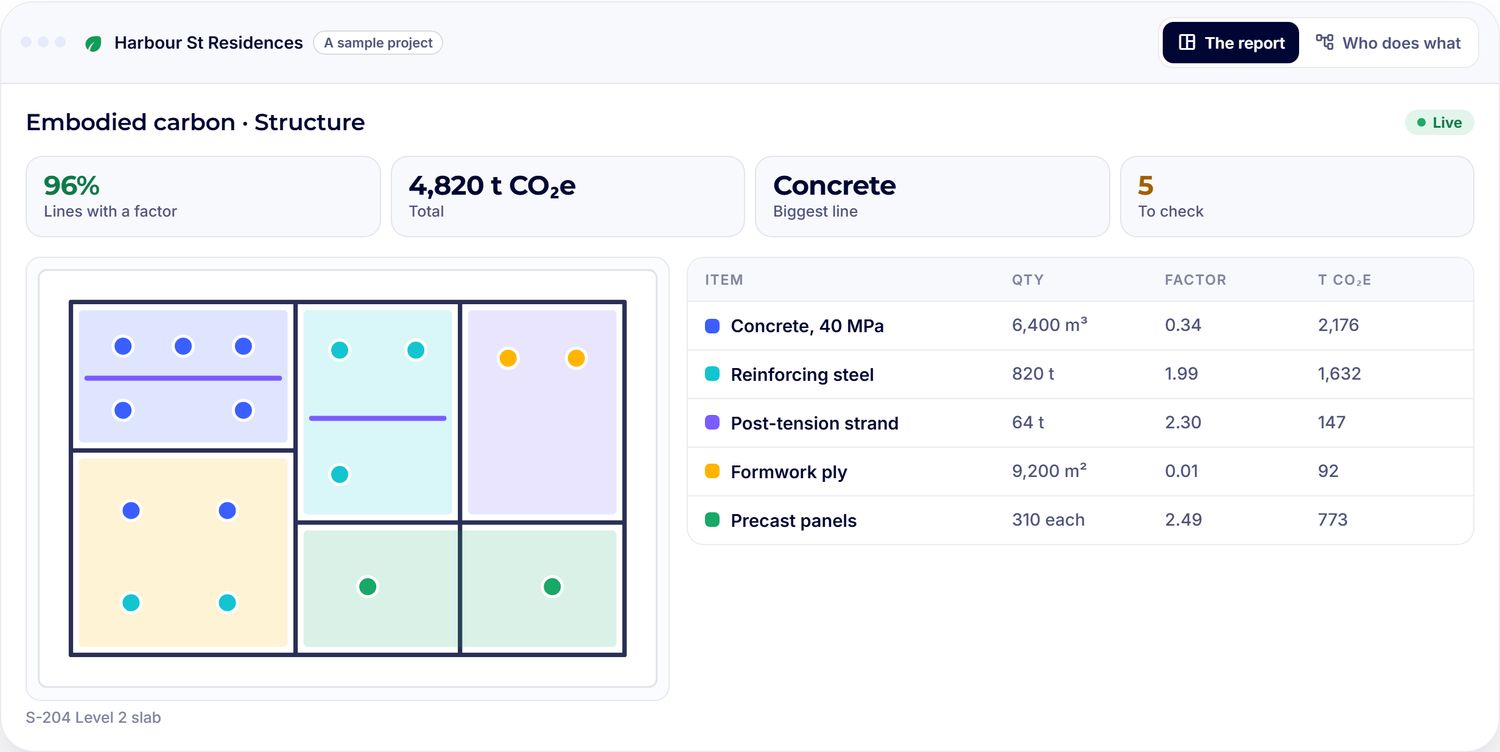
Walk into the audit with the number already done. Matrak Carbon puts embodied carbon on every line of the bill, every revision.
How to do a whole life carbon assessment
- Set the scope. Building parts, life cycle modules, study period and the floor area measure.
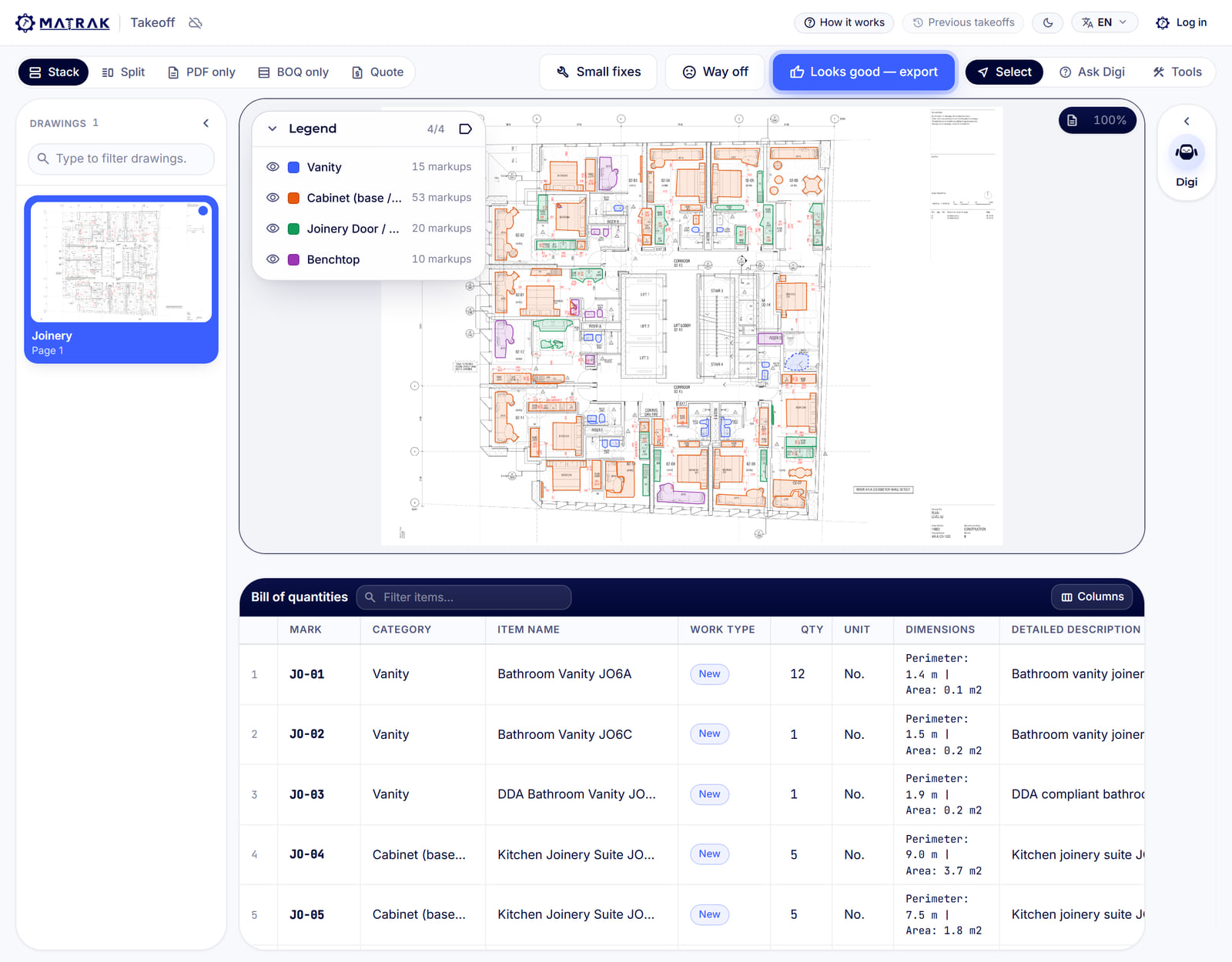
- Get the quantities. Every material in the building, from the cost plan, the model or a takeoff of the drawings.
- Choose the carbon factors. Product EPDs first, then industry averages, then generic databases.
- Add transport and construction. Modules A4 and A5, including site waste.
- Model the use stage. Replacement cycles, and energy and water from the energy model.
- Model end of life, and report module D separately.
- Report by module and by building element, in kg CO2e per m2, against a benchmark or target.
- Repeat when the design changes.
Worked example: upfront carbon for a structure
A 5,000 m2 office. Structure only, modules A1 to A3. The factors are made up for the example.
| Material | Quantity | Factor, A1 to A3 | Carbon |
|---|---|---|---|
| Concrete | 2,400 m3 | 300 kg CO2e per m3 | 720 t CO2e |
| Reinforcing steel | 260 t | 1,500 kg CO2e per t | 390 t CO2e |
| Structural steel | 120 t | 2,000 kg CO2e per t | 240 t CO2e |
| Formwork and other | Allowance | 50 t CO2e | |
| Total | 1,400 t CO2e |
That is 280 kg CO2e per m2 for the structure alone. The full assessment adds the facade, services and fit-out, then modules A4 to C4. Thin a slab or change a column grid and every line moves: the assessment is only as current as its quantities.
Common mistakes
- Quantities from an old revision. The design moved on and the carbon did not.
- Leaving out services and fit-out. They are replaced several times in 60 years.
- Netting off module D to make the total look better. Report it separately.
- Mixing carbon databases without saying so.
- One assessment at planning, then never again.
- A benchmark that covers different modules or different building parts.
- Carbon stored in timber counted as a saving without modelling its end of life.
Carbon that keeps up with the drawings
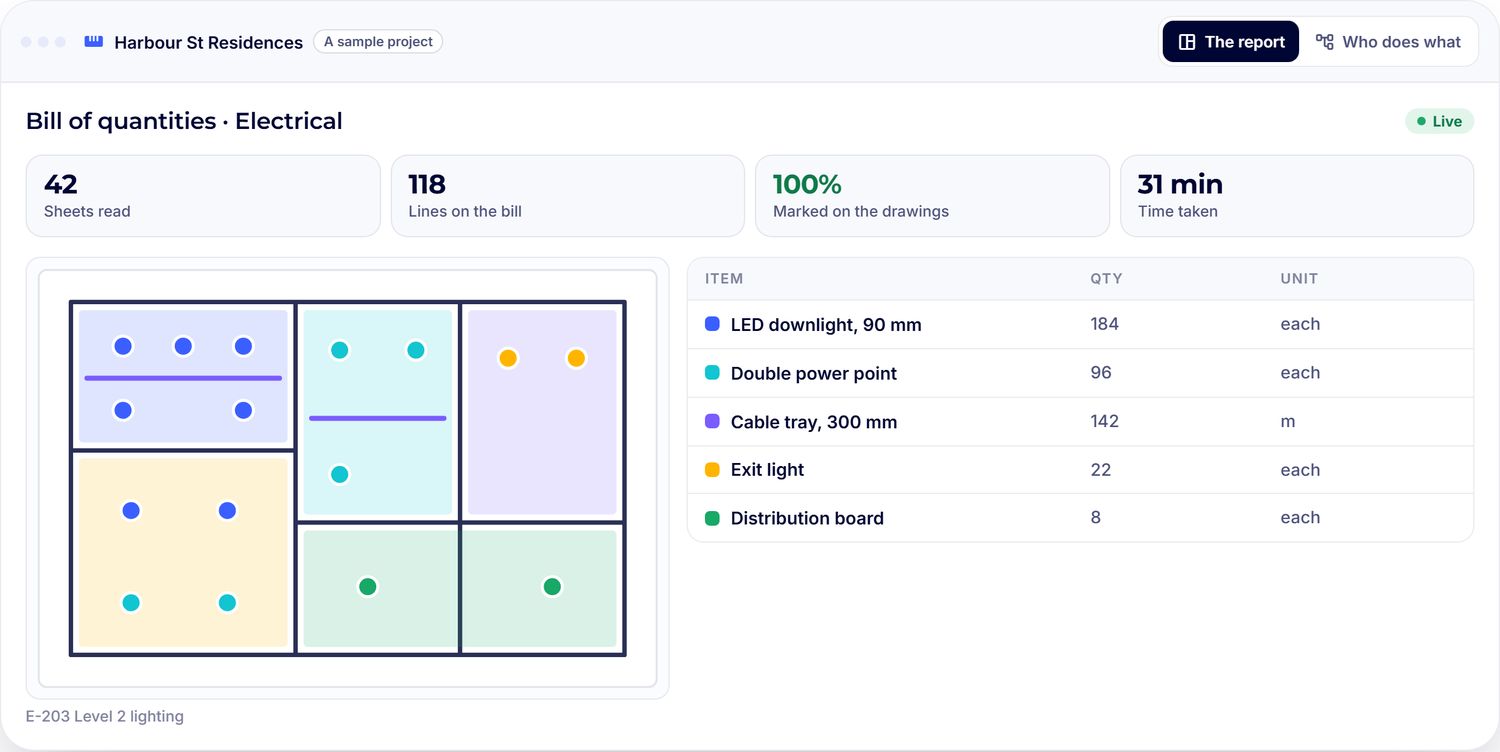
How Matrak does it. The slow half of a whole life carbon assessment is the quantities. Matrak AI Takeoff measures the whole project from the drawings, and Matrak Carbon puts embodied carbon on every line, with the total in tonnes of CO2e and the lines still missing a factor. $89 a credit, pay as you go (A$, plus GST).
Why it is never out of date. Carbon is redone on every revision, so the figure follows the design. Drawings come from Procore, Aconex and Autodesk, and on Aconex a scheduled task can re-run it as new drawings land. Each run is kept in a full audit history.
Frequently asked questions
What is a whole life carbon assessment?
It is a calculation of all the greenhouse gas emissions linked to a building over its life: materials, construction, use, maintenance, replacement and end of life, reported in kg CO2e and usually per square metre.
What is the difference between whole life carbon and embodied carbon?
Embodied carbon is the emissions from materials and construction, maintenance and end of life. Whole life carbon is embodied carbon plus operational carbon, the emissions from the energy and water used to run the building.
Is a whole life carbon assessment mandatory?
In London, yes for the larger developments referred to the Mayor, under the London Plan. Elsewhere in the UK it depends on the local authority and the client. Other countries, including France, the Netherlands and Denmark, already regulate whole life or embodied carbon, and more are following.
Who carries out a whole life carbon assessment?
Usually a sustainability consultant, quantity surveyor or engineer trained in the method, using quantities from the design team or the contractor. The quality of the result depends on the quantities and the carbon data they are given.
What study period does a whole life carbon assessment use?
The RICS standard sets a reference study period of 60 years for buildings and 120 years for infrastructure, so results from different projects can be compared.
What units is whole life carbon reported in?
Kilograms of carbon dioxide equivalent (kg CO2e), usually also divided by floor area as kg CO2e per m2, and broken down by life cycle module and building element.