An application for payment template is a form a contractor or subcontractor fills in to ask for an interim payment: the value of work done to date, less retention and what has already been paid, ending in the sum due and how it was worked out. Download ours below, free, for Excel.
This guide uses UK terms. The same request is a progress claim in Australia and New Zealand, and a pay application with a schedule of values in the US and Canada.
What is an application for payment in construction?
Under the Construction Act (the Housing Grants, Construction and Regeneration Act 1996, as amended), most UK construction contracts lasting 45 days or more must provide for interim payments. Where the contract provides for applications, an application for payment is how the payee starts each one. It follows an interim valuation of the work at the valuation date, and it must state the sum the applicant considers due and the basis on which that sum is calculated.
What to put in an application for payment
- The parties, the contract and the application number.
- The valuation date and the due date it relates to.
- Each part of the work, with its contract value and percentage complete.
- Variations, agreed and claimed, listed separately.
- Materials on site, where the contract lets you value them.
- Less retention at the contract rate, and less what has been paid before.
- The sum due, then VAT. Where the VAT domestic reverse charge applies, say that the customer accounts for it.
- The evidence: measures, photos, delivery notes, signed dayworks.
Payment notice and pay less notice: the dates
| Step | Who | When | What it does |
|---|---|---|---|
| Application for payment | Payee | By the date the contract sets, tied to the valuation date | States the sum considered due and how it is calculated |
| Payment notice | Payer, or a person the contract names | Not later than 5 days after the payment due date | States the sum the payer considers due, and the basis |
| Pay less notice | Payer | The contract's period before the final date for payment: 7 days under the Scheme | States the lower sum the payer will pay, and the basis |
| Payment | Payer | By the final date for payment | The notified sum, or the sum in a valid pay less notice |
If the payer serves no payment notice in time, a valid application can stand as the notice, and its sum must be paid unless a pay less notice is served. That is why the dates and the wording on your application matter. JCT, NEC and bespoke contracts set different dates, so read yours.
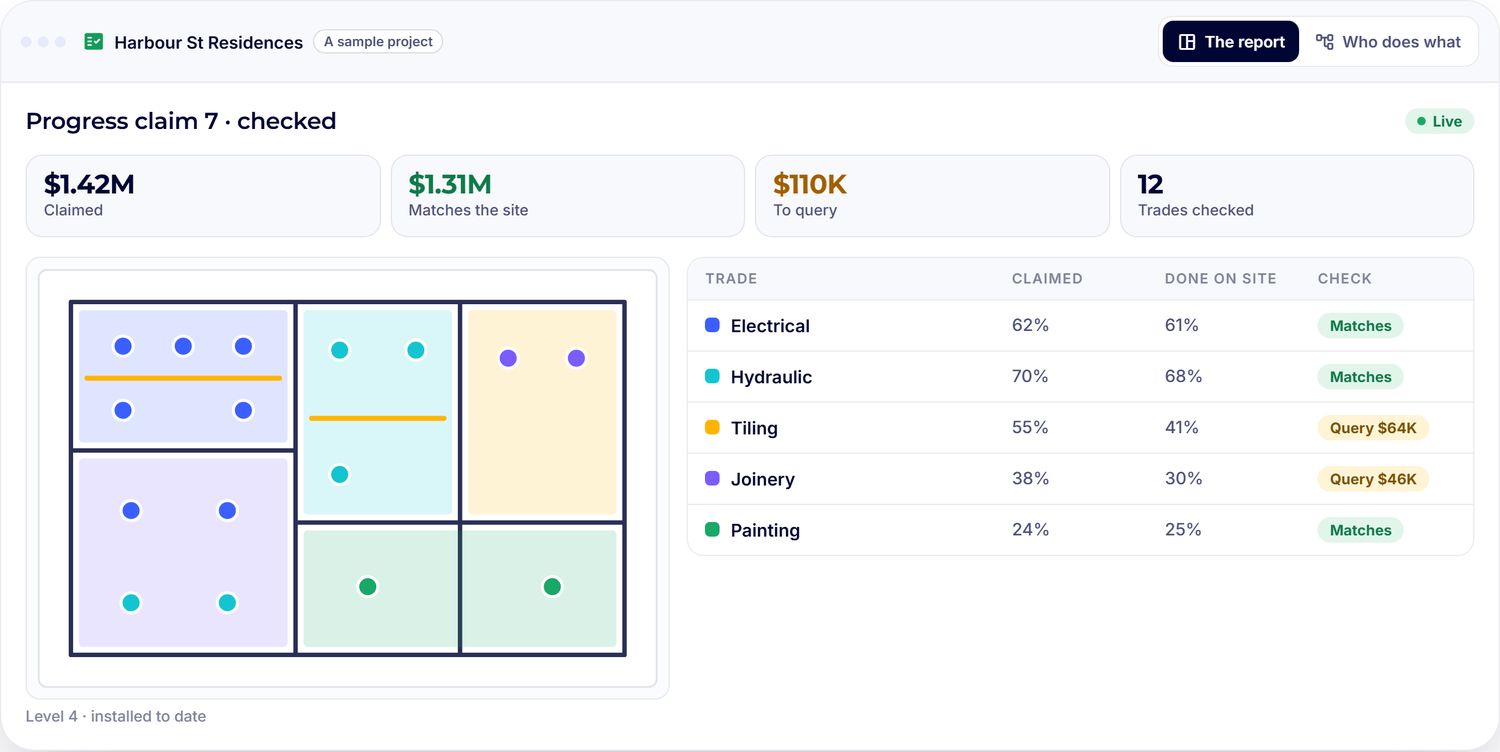
Claims that match the site. Matrak Claims puts what is applied for beside what is built, trade by trade.
Worked example: an interim valuation
A drylining subcontractor's third application on a £120,000 package, with 3% retention.
| Ref | Description | Contract value | % complete | Gross to date | Previously applied | This application |
|---|---|---|---|---|---|---|
| 1 | Preliminaries | £12,000 | 60% | £7,200 | £4,800 | £2,400 |
| 2 | Metal stud partitions, Levels 1 to 3 | £48,000 | 75% | £36,000 | £24,000 | £12,000 |
| 3 | Plasterboard, tape and joint | £36,000 | 50% | £18,000 | £9,000 | £9,000 |
| 4 | Suspended ceilings | £24,000 | 25% | £6,000 | £0 | £6,000 |
| Total | £120,000 | 56% | £67,200 | £37,800 | £29,400 |
Free application for payment template
Take our application for payment template for Excel: the dates, the works valued by percentage, and the sum due worked out for you. The drylining example is filled in. No sign-up. Add £2,300 of variations and £1,500 of materials on site to the works above, and it ends like this:
| Line | Amount |
|---|---|
| Gross valuation | £71,000 |
| Less retention at 3% | £2,130 |
| Less previous payments | £36,666 |
| Amount due, excluding VAT | £32,204 |
Common mistakes on a payment application
- Sent late, or to the wrong person. A late application may not count for that payment cycle at all.
- No clear sum due. One figure, with the working shown.
- Not obviously an application. Courts have refused to treat vague emails and spreadsheets as valid applications. Title it and quote the contract.
- Variations with no backup. Attach the instruction and the measure.
- Claiming work that is not there. The valuation is of work properly done at the valuation date.
- Ignoring a pay less notice. Check it was in time and gives its basis. If it does, the route is to challenge the valuation, usually by adjudication.
Software that backs up an application
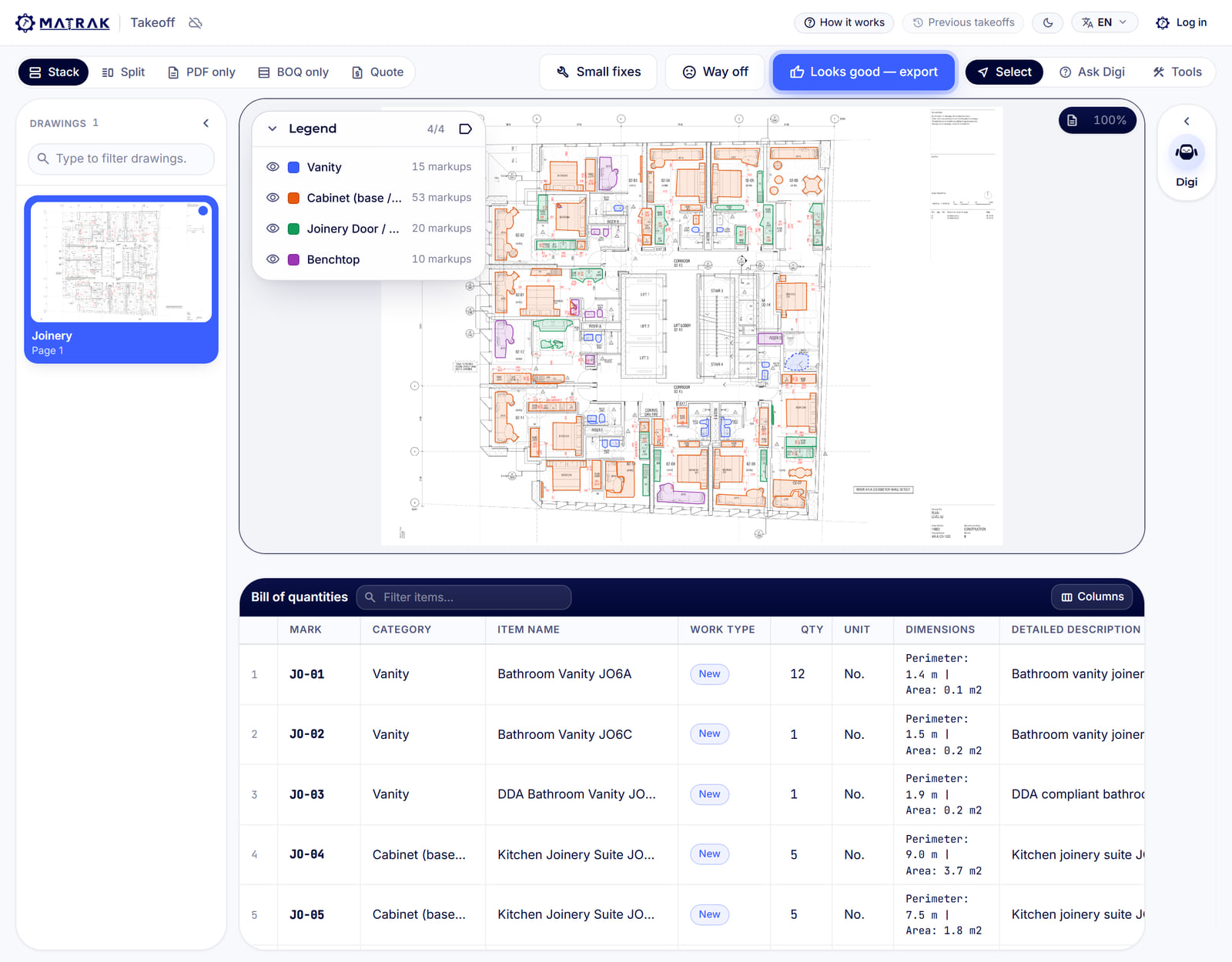
How Matrak does it. Matrak Claims assesses each application from the drawings and the site. Quantities off the drawings set what 100% of each line is, and the install record sets the percentage, so the sum applied for and the work built sit side by side. $400 a month, with 8 AI credits included (A$, plus GST).
Why the argument ends early. Payer and payee read one drawing and one record, before the payment notice is due. Matrak works with Procore, Aconex and Autodesk, so drawings arrive without a download, and a full audit history shows every edit to the claim.
Half the retention normally comes back at practical completion: see retention in construction. Comparing payment tools? Matrak beside Payapps.
Frequently asked questions
What is an application for payment?
It is a contractor's or subcontractor's written request for an interim payment under a construction contract. It states the sum considered due at the due date and shows how that sum was calculated.
Is an application for payment the same as an invoice?
No. An application says what you consider due and why. A VAT invoice is the tax document, often raised only after the amount is agreed or certified. Many subcontracts ask for the application first and the invoice after the payment notice.
What is a pay less notice?
A notice from the payer that it intends to pay less than the notified sum. It must state the sum the payer considers due and the basis for it, and be given no later than the prescribed period before the final date for payment: seven days under the Scheme for Construction Contracts, unless the contract sets a different period.
What happens if no payment notice or pay less notice is served?
Where a valid application was made on time and the payer serves no payment notice, the application can stand as the payment notice. Without a valid pay less notice, the sum in it must be paid by the final date for payment. The payer can still dispute the true value afterwards, normally after paying.
What is the difference between an interim valuation and an application for payment?
The interim valuation is the assessment of the value of the work at the valuation date. The application for payment is the document that asks for payment on the strength of it. Under some contracts the contract administrator or quantity surveyor values the work and issues a certificate instead.
Does this apply outside the UK?
The notice rules here are from UK law. Australia, New Zealand, Ireland and Canada's provinces have their own security of payment or prompt payment laws, with different dates. The template's layout works anywhere. The deadlines do not.