A schedule of values template is a spreadsheet that splits a construction contract sum into lines of work, each with a dollar value, so progress is billed against each line. It sits behind every pay application. Download ours below, free, with the formulas working.
Schedule of values and pay application are US and Canadian terms. In Australia the same job is done by a progress claim with a trade breakdown, and in the UK by an application for payment.
What is a schedule of values?
A construction schedule of values (SOV) lists every part of the work and the share of the contract sum given to it. The lines add up to the contract sum exactly. It is agreed with the owner or architect before the first bill and only changes when a change order changes it. Each month you fill in how much of each line is done, and that works out what you are owed.
The columns, one by one
| Column | What goes in it |
|---|---|
| Item no and description | One line per part of the work: by trade, area or cost code |
| Scheduled value | The share of the contract sum for that line |
| From previous applications | Work billed on that line in earlier periods |
| This period | Work done on that line since the last application |
| Materials presently stored | Materials bought and stored, on or off site, not yet built in |
| Total completed and stored | The three columns before it, added together |
| % complete | Total completed and stored, divided by the scheduled value |
| Balance to finish | Scheduled value, less total completed and stored |
| Retainage | The share of the total the owner holds back until the end |
How a pay application uses it
A construction pay application is a summary page with the schedule of values behind it. The summary takes the schedule's totals and works down to the cheque:
- Contract sum to date: the original sum plus approved change orders.
- Total completed and stored to date.
- Less retainage.
- Less previous payments.
- Current payment due.
On many US projects the forms are AIA documents G702 (the application) and G703 (the continuation sheet, which is the schedule of values). If your contract calls for an AIA pay application, use the licensed AIA forms. Our template follows the same logic for jobs where you may use your own.
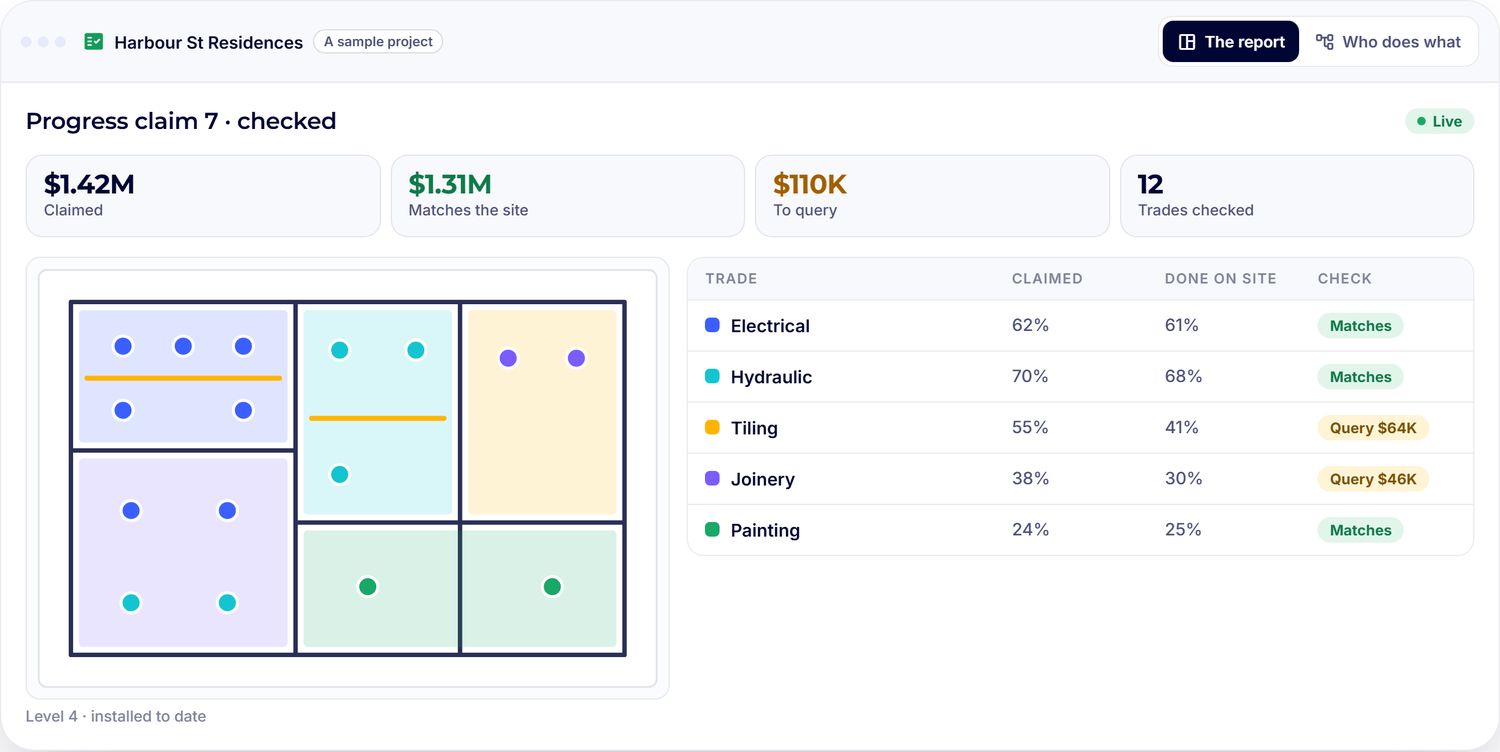
Stop paying for work that is not done yet. Matrak Claims checks every line claimed against the drawings and what is done on site.
Worked example: application 3 on a fit-out
A $300,000 office fit-out, six lines, 10% retainage.
| Item | Description | Scheduled value | Previous | This period | Stored | Total to date | % | Balance |
|---|---|---|---|---|---|---|---|---|
| 1 | General conditions | $40,000 | $16,000 | $8,000 | $0 | $24,000 | 60% | $16,000 |
| 2 | Demolition | $25,000 | $25,000 | $0 | $0 | $25,000 | 100% | $0 |
| 3 | Framing and drywall | $90,000 | $36,000 | $27,000 | $4,500 | $67,500 | 75% | $22,500 |
| 4 | Electrical | $70,000 | $14,000 | $21,000 | $0 | $35,000 | 50% | $35,000 |
| 5 | Flooring | $45,000 | $0 | $0 | $9,000 | $9,000 | 20% | $36,000 |
| 6 | Painting | $30,000 | $0 | $3,000 | $0 | $3,000 | 10% | $27,000 |
| Total | $300,000 | $91,000 | $59,000 | $13,500 | $163,500 | 55% | $136,500 |
Free schedule of values template
Take our schedule of values template for Excel. It doubles as a pay application template: fill in the schedule and the summary page works out the payment due. The example is included. No sign-up. The summary for the job above:
| Line | Amount |
|---|---|
| Total completed and stored to date | $163,500 |
| Less retainage at 10% | $16,350 |
| Less previous payments | $81,900 |
| Current payment due | $65,250 |
Common mistakes that delay payment
- Lines that do not add up to the contract sum. The first thing a reviewer checks.
- Too few lines. "Electrical, $70,000" cannot be checked. Split it by level or stage.
- Front-loading. Early lines stuffed with value get the schedule sent back.
- A percentage the site does not show. The reviewer walks the job.
- Change orders buried in original lines. Add each approved change as its own line.
- Stored materials with no proof. Attach invoices and photos, and insurance where the contract asks.
- The wrong retainage. Check the rate and whether it drops at 50% complete.
Software that checks a pay application
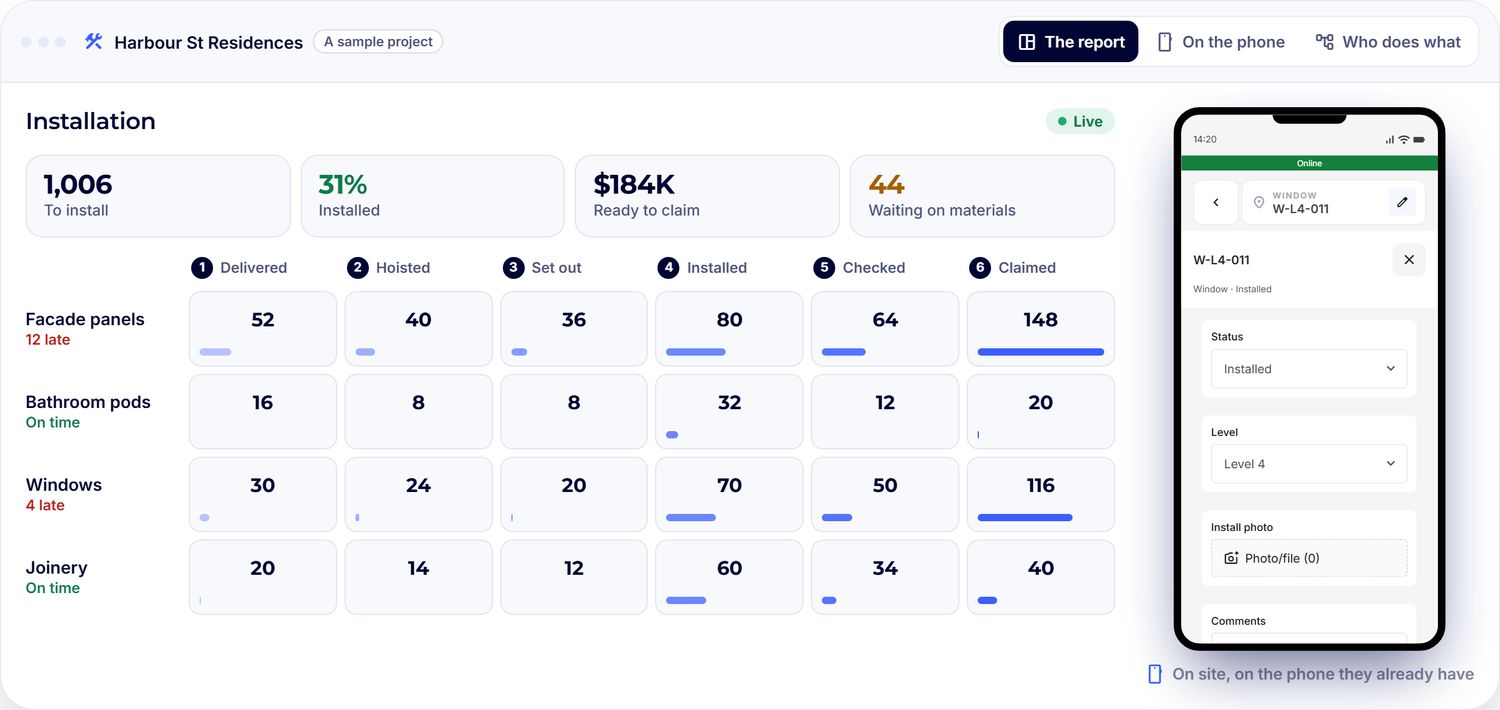
How Matrak does it. Matrak Claims puts the percentage claimed beside the percentage done on site, for every trade. Quantities measured off the drawings set what 100% is, so a line claimed at 55% against 41% installed stands out with its dollar value. $400 a month, with 8 AI credits included (A$, plus GST).
Why the review is short. Both sides look at the same drawing and the same count of what is installed. Drawings come from Procore, Aconex and Autodesk with nothing to download, and a full audit history records who changed what.
Looking at pay application software? See Matrak beside Payapps, or every comparison. Retainage is usually released at practical completion, called substantial completion in North America.
Frequently asked questions
What is a schedule of values in construction?
It is a list that breaks the contract sum into lines of work, each with a dollar value. It is agreed at the start of the job and used every billing period to work out how much of the contract has been earned.
Who prepares the schedule of values?
The contractor prepares it and submits it before the first pay application. The owner, architect or lender reviews and accepts it. Subcontractors prepare their own for their subcontract.
How detailed should a schedule of values be?
Detailed enough that someone walking the site can check each line. Split big trades by level, area or stage, and keep general conditions, mobilisation and closeout as their own lines.
What is the difference between a schedule of values and a pay application?
The schedule of values is the breakdown of the contract sum. The pay application is the request for payment that uses it: a summary of what is earned, retained and already paid, with the updated schedule attached.
What is retainage on a pay application?
Retainage is a share of each payment, often 5% to 10%, that the owner holds until the work is substantially complete. It is called retention in Australia, New Zealand and the UK. Many US states cap it by law, so check your contract and your state's rules.
Do I need the AIA pay application forms?
Only if the contract asks for them. Where the contract names the AIA forms, use the licensed AIA documents. Where it only asks for an application with a schedule of values, a spreadsheet with the same columns is commonly accepted.