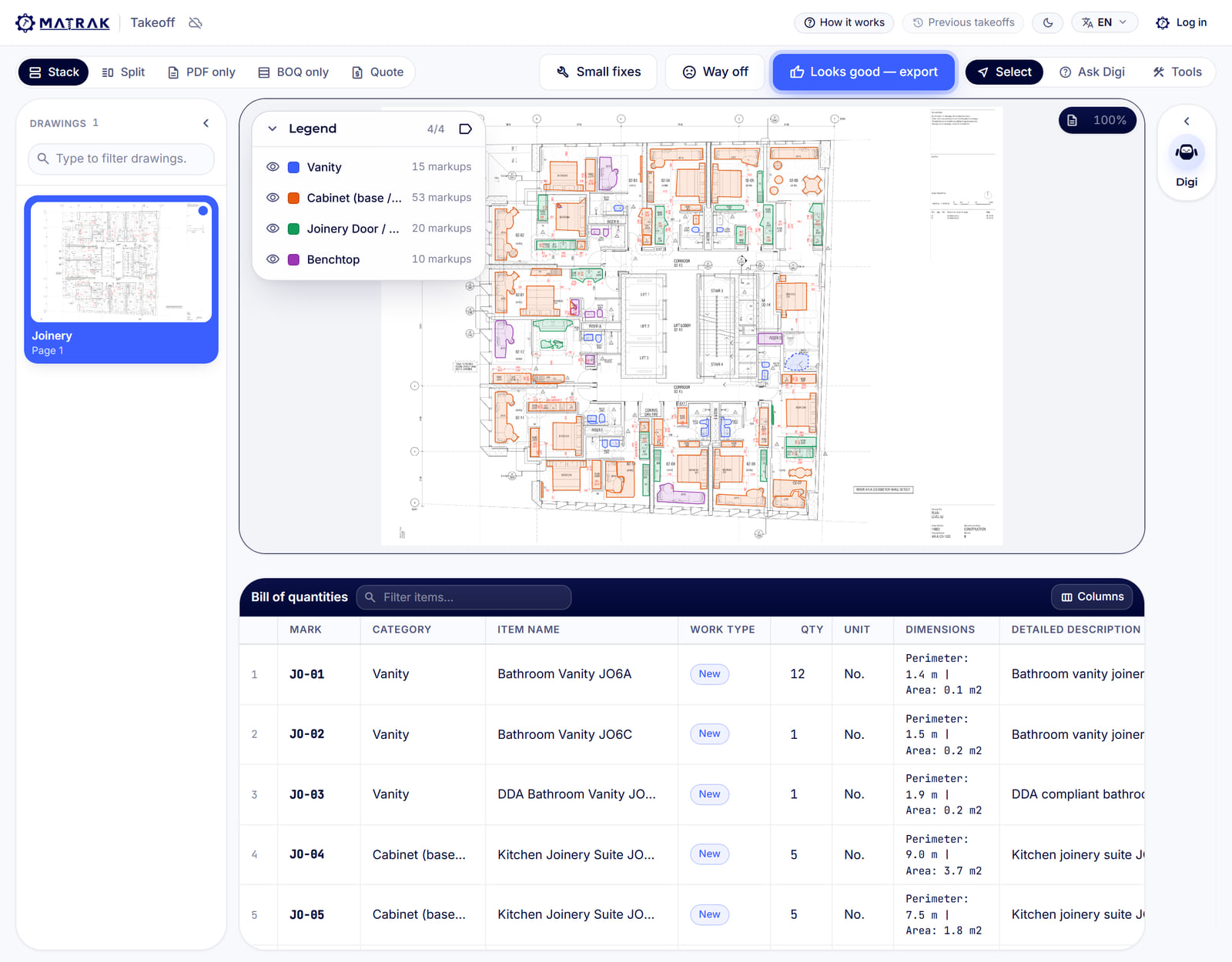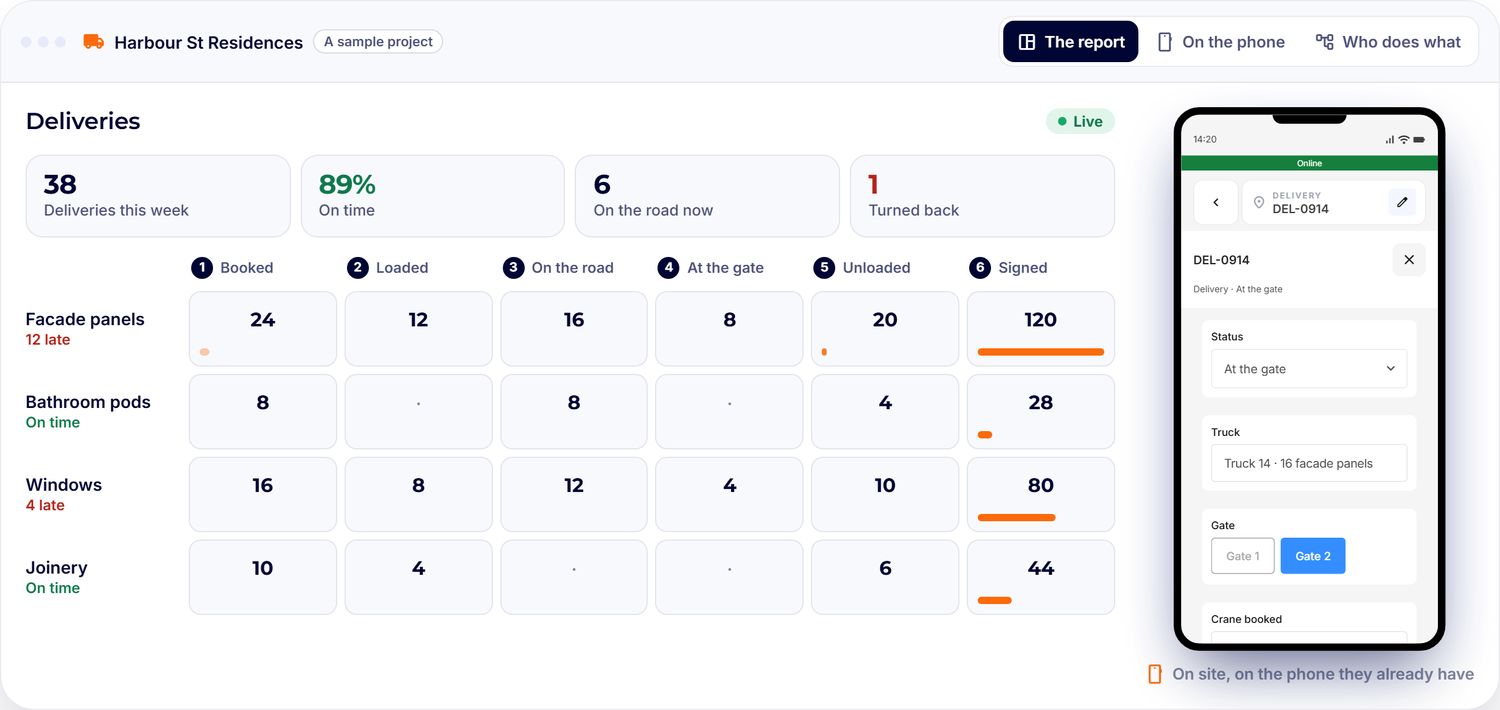
An RFI in construction is a request for information: a formal written question from a contractor or subcontractor to the design team when the drawings or specification are unclear, incomplete or in conflict. The answer is recorded, so everyone builds the same thing. A free RFI log template is below.
RFI means the same in Australia, the US, Canada, New Zealand and the UK. Some UK and Australian projects call it a technical query (TQ).
When to raise an RFI in construction
- Two documents disagree. The plan shows one thing and the schedule another.
- Something is missing. A dimension, a level, a fixing detail.
- It cannot be built as drawn. A clash, no access, a discontinued product.
- The site is not what the drawings show. An existing service, a different slab level, rock where the report said clay.
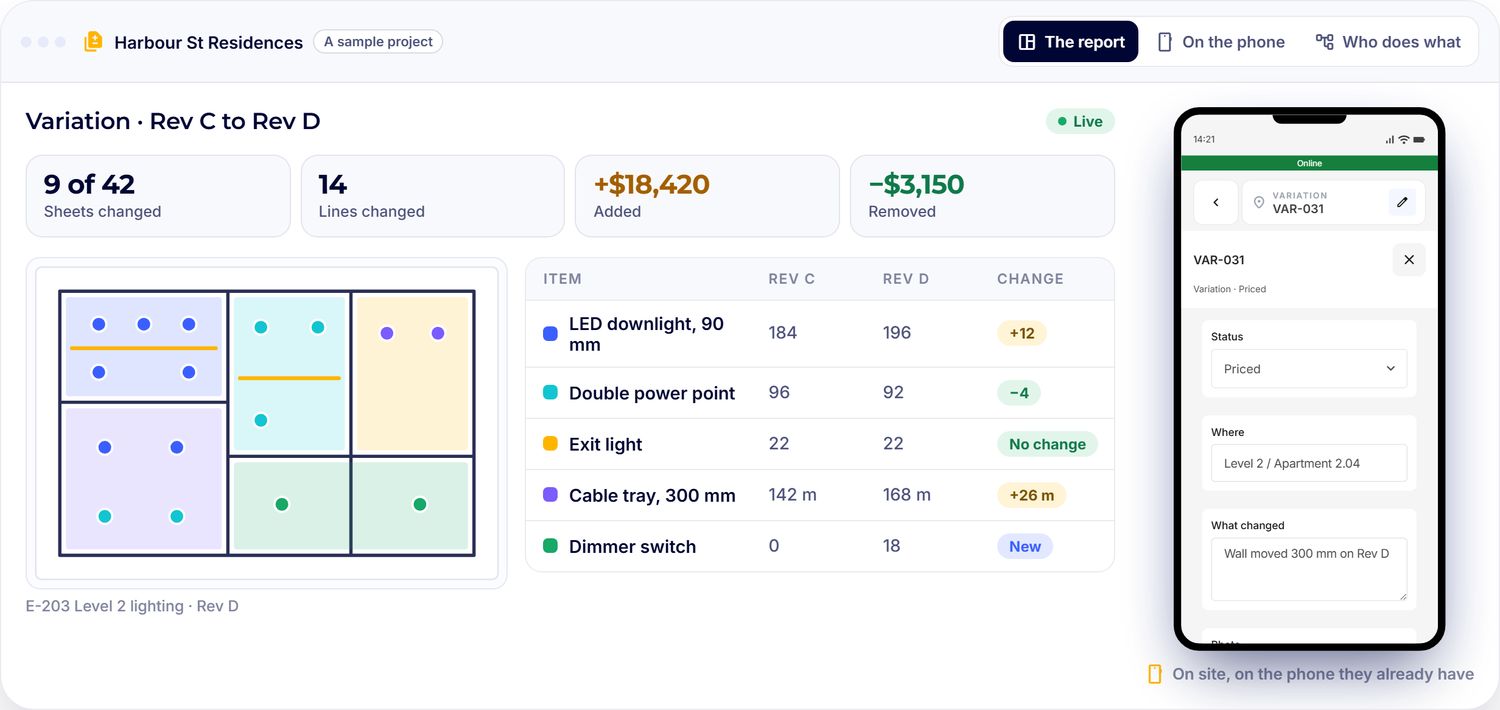
Do not raise an RFI for something the documents already answer, to get your method approved, or to claim money. Raise it the day you see the problem: an RFI sent the week before the pour is already late. A change to cost or time goes through the variation process, called a change order in North America.
The RFI process in construction
- Check the documents first, including the latest revisions.
- Write one clear question, with the drawing number, revision, grid and a marked-up snip or photo.
- Propose an answer if you have one.
- Give the date you need it by, and what is held up.
- Log it and send it through the agreed channel.
- The designer answers within the contract's response time, often five to ten working days.
- Record the answer, tell the trades it affects, and close it once the drawings or the work reflect it.
- If the answer changes cost or time, give notice under the contract straight away.
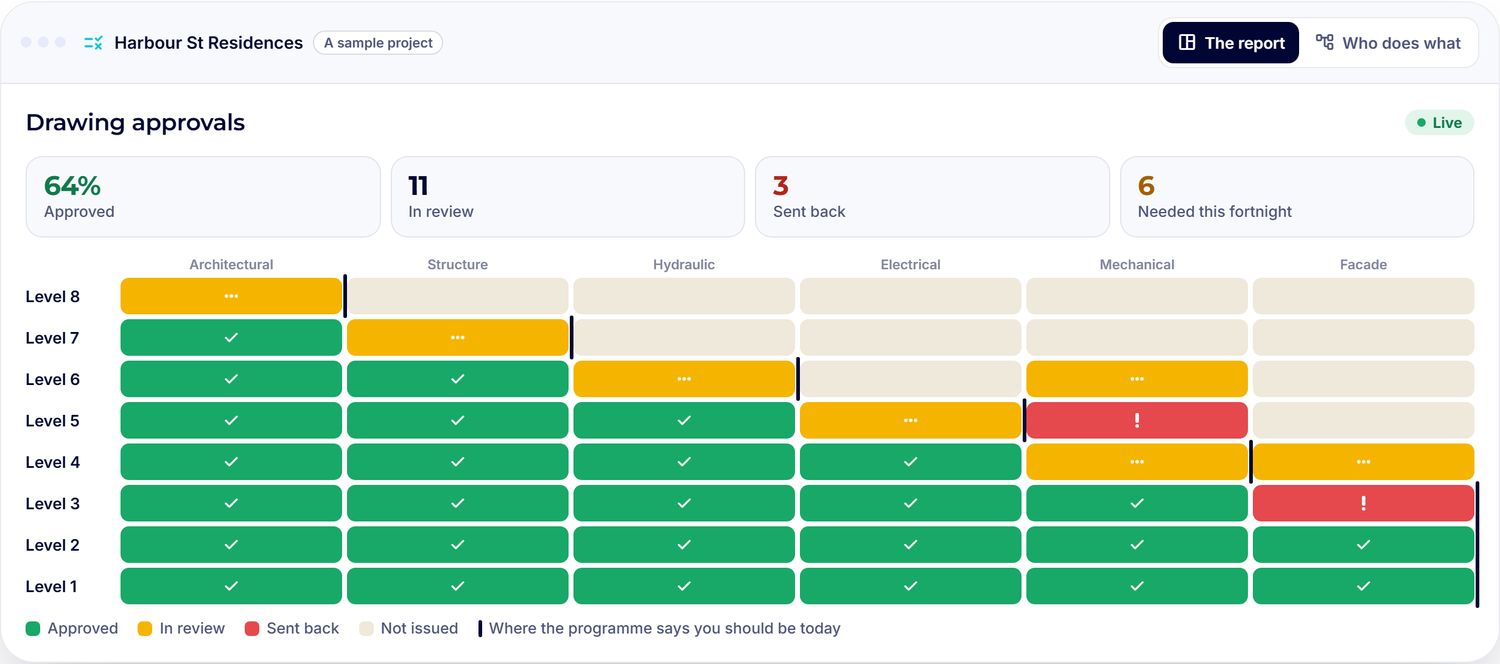
See the late drawing while there is still time to fix it. Matrak Design management tracks every drawing's approval against the date the programme needs it.
A weak RFI and a strong one
| Weak RFI | Strong RFI | |
|---|---|---|
| Question | 'Please clarify the facade glass.' | 'A-201 rev B shows 12 mm glass. The glazing schedule rev A shows 10 mm. Which is correct?' |
| Reference | None | Drawing numbers, revisions, grid, a marked-up snip |
| Proposal | None | 'We propose 12 mm, to match the elevation.' |
| Needed by | 'ASAP' | '26 October. The glass order closes on 30 October.' |
Free RFI log template
An RFI log is the register of every RFI: who asked, what, when, who has to answer, by when, and what it led to. Take ours for Excel: the log with days open counted for you, a one-page RFI form, and three examples. No sign-up.
| RFI no | Raised | Question | Sent to | Needed by | Answered | Days open | Status |
|---|---|---|---|---|---|---|---|
| RFI-001 | 5 Oct | Penetration at C4 clashes with the band beam. Can it move 400 mm east? | Structural engineer | 12 Oct | 9 Oct | 4 | Closed |
| RFI-002 | 19 Oct | Elevation shows 12 mm glass, schedule shows 10 mm. Which is correct? | Architect | 26 Oct | 28 Oct | 9 | Answered |
| RFI-003 | 16 Nov | No ceiling height for the Level 3 corridor. What height for the cable tray? | Architect | 23 Nov | 7 | Open |
Common mistakes with RFIs
- Asking what the documents already say. It slows the real questions down.
- Several questions in one RFI. One gets answered and the rest get lost.
- No drawing reference. The designer has to guess which sheet and revision you mean.
- No date and no consequence. "ASAP" goes to the bottom of the pile.
- Building on a verbal answer. Get it in writing, and note the conversation in the site diary the same day.
- Answers that never reach site. Update the drawing register and tell the trades.
- RFIs used to build a claim. Flooding the designer with questions sours the job.
- A log nobody reviews. Go through the open ones every week.
Fewer RFIs, faster answers
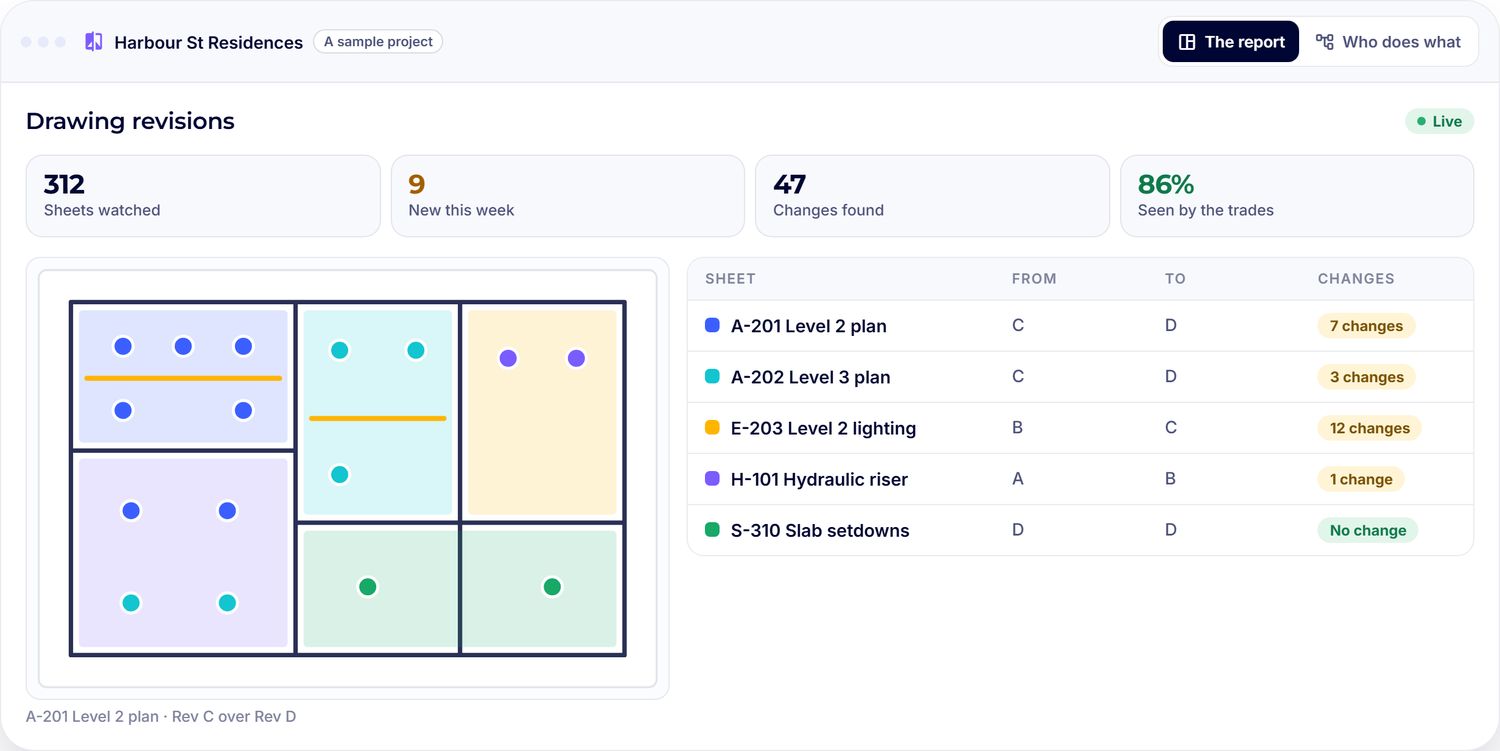
How Matrak does it. Keep your RFIs in Procore or Aconex. Many trace back to a revision nobody noticed, so Matrak Revisions marks what changed the day a drawing lands. Design management tracks every drawing's approval and chases overdue responses by email and in the app. It is $350 a month, with 4 AI credits (A$, plus GST).
Why the answer arrives in time. Connect your Procore or Aconex and the AI design manager starts. On Aconex, the Aconex MCP lets you ask Digi which drawings are still out for approval. Matrak works with Procore, Aconex and Autodesk and keeps a full audit history of every change.
Related: construction submittals, shop drawings and document control in construction. Compare Matrak.
Frequently asked questions
What does RFI stand for in construction?
RFI stands for request for information. It is a formal written question about the drawings, specification or contract documents, sent to the party who can answer it, usually the architect or engineer.
Who answers an RFI?
The designer responsible for the document in question: the architect for architectural drawings, the engineer for structure or services. RFIs from subcontractors normally go through the head contractor, who checks them and passes them on.
How long does an RFI response take?
The contract sets the response time. Five to ten working days is common. Say in the RFI when you need the answer and what work is waiting on it, and raise it as early as you can.
Is an RFI a variation or change order?
No. An RFI asks a question. If the answer changes the scope, cost or time, the change is dealt with separately under the contract's variation or change order clause, usually with a notice period.
What is the difference between an RFI and a submittal?
An RFI is a question to the design team. A submittal is information the contractor sends for review, such as shop drawings, product data or samples, to show what it plans to build.
What should an RFI log include?
The RFI number, date raised, who raised it, the question, the drawing reference, who it was sent to, the date an answer is needed, the date answered, days open, status, and whether it had a cost or time impact.